Most Forex traders spend years chasing a better strategy. They switch indicators, test new entry models, and follow different mentors, all while the actual variable holding them back never changes: their own process. Two traders can use the exact same strategy and get completely different results, because the difference isn't the setup, it's how consistently and honestly they track, review, and adjust their own execution. That's the entire purpose of a Forex trading journal.
This guide won't promise you a higher win rate or claim that journaling guarantees profitability. No journal can do that. What it can do, when used consistently, is give you an honest, evidence-based view of what you're actually doing in the market, which is the first real step toward improving it.
What Is a Forex Trading Journal?
A Forex trading journal is a structured record of every trade you take, along with the context around it, entry logic, risk taken, and the outcome. It's easy to confuse this term with two related concepts that actually serve slightly different purposes.
A trading log is the raw layer: currency pair, entry, exit, and result. It's data without much interpretation.
A trading journal builds on the log by adding structure, statistics, and performance metrics, things like win rate, average R-multiple, and risk-reward across your trade history.
A trading diary is the most personal layer, capturing the emotional and psychological side of trading: what you were thinking, how confident or anxious you felt, and what you noticed about your own decision-making.
A complete Forex trading journal typically blends all three. The log gives you facts, the journal gives you statistics, and the diary gives you self-awareness. Traders who only track the numbers and skip the emotional context tend to repeat the same behavioral mistakes without ever identifying why.
Why Every Successful Forex Trader Keeps a Journal
Ask any experienced Forex trader how they improved over time, and the answer rarely involves finding a "better" strategy. It almost always involves reviewing their own trades more carefully. A journal supports this in a few specific ways.
Learning from mistakes
A written record makes it possible to identify recurring errors, like consistently entering too early or ignoring higher timeframe structure, that would otherwise blend into a blur of memory.
Building consistency
Consistency in Forex trading isn't about winning every trade, it's about executing the same process repeatedly. A journal makes it possible to actually measure whether that's happening.
Risk awareness
Logging risk percentage and lot size on every trade reveals whether position sizing is staying disciplined or slowly drifting upward after a string of wins.
Emotional control
Recording emotion before and after each trade builds awareness of patterns like revenge trading after a loss or overconfidence after a winning streak, two of the most common ways discipline breaks down.
Performance reviews
Without a journal, a weekly or monthly review is based on impression and memory. With one, it's based on actual data, which tends to be a far more honest reflection of performance.
What Should You Record After Every Forex Trade?
The more specific your journal entries, the more useful they become during review. A thorough Forex trading journal entry typically includes the following fields:
| Field | Purpose |
|---|---|
| Currency Pair | Identifies which pairs perform best with your strategy |
| Trade Direction | Buy or sell, useful for spotting directional bias over time |
| Entry | Confirms actual entry versus planned entry |
| Exit | Records where the trade was actually closed |
| Stop Loss | Shows whether risk was defined before entering |
| Take Profit | Reveals whether targets were realistic and consistently used |
| Risk % | Tracks whether position sizing stayed within your rules |
| Lot Size | Used to calculate exposure and risk accurately |
| Result | Win, loss, or breakeven for statistical tracking |
| R-Multiple | Standardizes results across trades regardless of position size |
| Emotion Before Trade | Flags impulsive or fear-driven entries |
| Emotion After Trade | Highlights emotional reactions that could affect the next decision |
| Lesson Learned | Converts each trade into a specific, actionable takeaway |
| Chart Screenshot | Provides visual context for later review |
| Trading Session | Reveals which session (London, New York, Asian) suits your strategy best |
The Biggest Mistakes Forex Traders Make
Keeping a journal only helps if it's done properly. A few recurring mistakes tend to undermine the habit before it produces any real value.
- No journal at all: The most common mistake by far. Without any record, review is based entirely on memory, which research in behavioral finance consistently shows is unreliable for self-assessment.
- Incomplete notes: Logging only the entry and result while skipping context makes it impossible to understand why a trade worked or failed.
- Ignoring emotions: Leaving out emotional state removes one of the most useful indicators of behavioral patterns.
- No weekly review: Logging trades without ever revisiting them defeats the purpose. The learning happens during review, not during entry.
- Changing strategies too often: Without a journal to prove whether a strategy is actually failing or simply going through a normal losing streak, traders often abandon viable approaches too early.
Excel vs Modern Trading Journal Software
Spreadsheets remain a reasonable starting point for traders logging their first trades. They're free, flexible, and require no learning curve beyond basic formulas. For low-frequency traders or those just building the habit, a simple spreadsheet log is often enough.
The limitations show up as trading volume and complexity grow. Manual formulas are prone to error, psychology and behavioral patterns aren't tracked automatically, and building reports or a P&L calendar by hand becomes time-consuming. This is where dedicated trading journal software becomes more efficient, particularly for active Forex traders managing multiple pairs and sessions. For a full breakdown of the practical differences, see our guide on Trading Journal Excel vs AI Trading Journal.
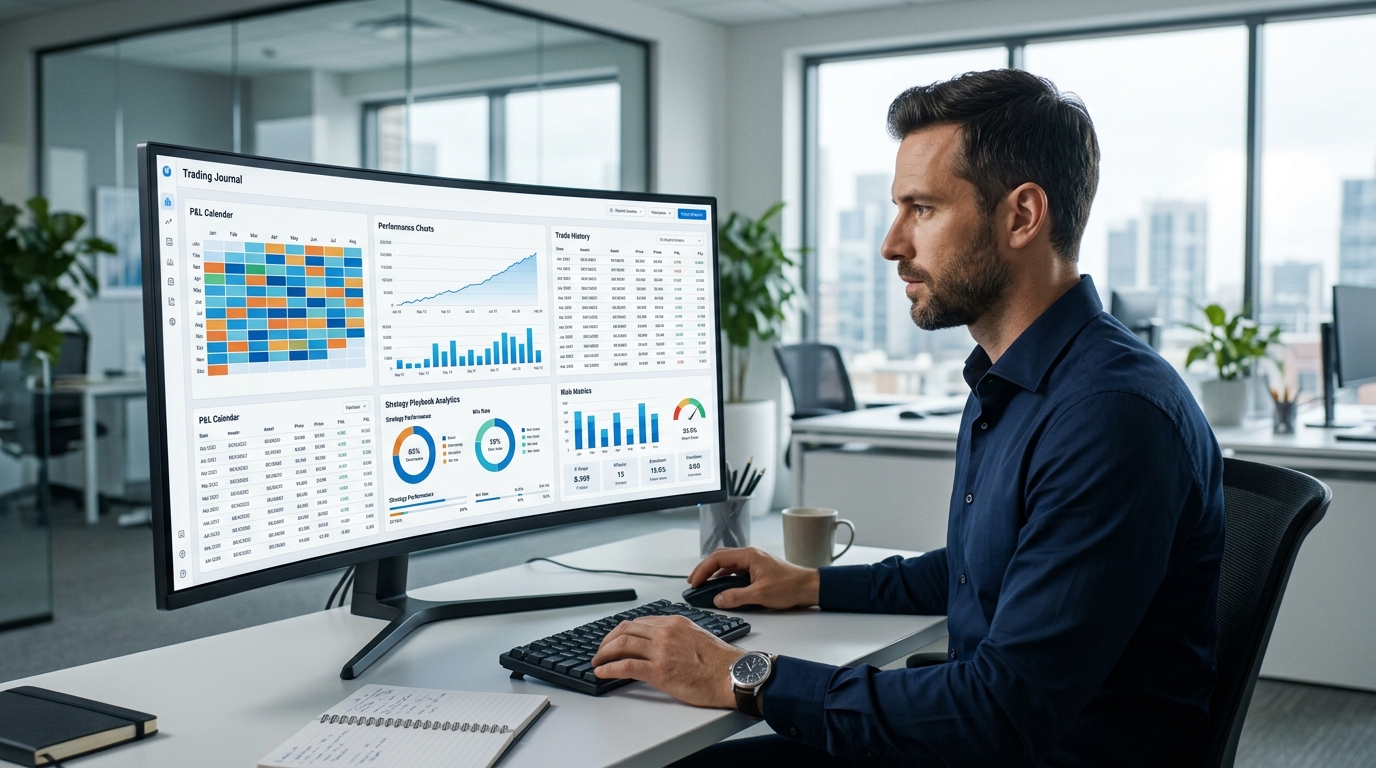
Platforms like DailyTraderz combine manual trade entry with a P&L calendar, risk tracking, and AI behavioral analysis, so a trader's journal, diary, and performance dashboard live in one place instead of being spread across spreadsheets and notes. This kind of structured, evidence-based self-review is widely supported in behavioral finance research, which consistently links disciplined performance review to more consistent decision-making over time. If you're comparing options beyond a single tool, our roundup of the Best Trading Journal Apps covers several platforms worth considering.
Frequently Asked Questions
What is a Forex trading journal used for?
It's used to record and review every trade you take, helping you identify patterns in your strategy, risk management, and psychology over time.
Is a Forex trading journal different from a regular trading journal?
The core concept is the same. A Forex-specific journal typically adds fields relevant to currency trading, like session timing, pip-based risk, and currency pair correlation.
How detailed should my Forex journal entries be?
Detailed enough to reconstruct your thinking later. At minimum, include entry, exit, risk, result, and a short note on emotion and lesson learned.
Can a trading journal improve my results?
A journal cannot guarantee improved results. It can help you identify mistakes and patterns that, once corrected, may support more disciplined execution over time.
Should I journal winning trades too?
Yes. Winning trades taken outside your plan can reinforce bad habits if they're never reviewed alongside losing ones.
What is an R-multiple and why track it?
An R-multiple expresses a trade's result relative to the risk taken, making it possible to compare performance across trades with different position sizes.
Do AI-powered trading journals give trading signals?
No. Legitimate AI trading journal tools analyze your own historical trades and behavior. They don't predict market movement or provide financial advice.
How often should I review my Forex journal?
A weekly review is generally recommended, since it's frequent enough to catch patterns early without being influenced by the emotion of a single session.
Is Excel enough for a Forex trading journal?
It can be, especially for lower trade volumes. As trading frequency and the need for psychology tracking increase, dedicated journal software tends to save significant time.
What features matter most in trading journal software?
Accurate trade tracking, a clear performance dashboard, risk metrics, and some form of psychology or behavioral tracking tend to matter most for long-term improvement.
If you're looking to bring your Forex trade tracking, risk management, and trading psychology into one structured system, DailyTraderz offers manual trade entry alongside a performance dashboard and AI-powered behavioral insights built to help you review your trading more clearly.