Ask any experienced trader what separates a good year from a bad one, and most won't point to a single winning trade. They'll point to their process. The traders who last in this business tend to share one habit that has nothing to do with predicting the market: they review their own decisions, consistently and honestly, in writing. That's the entire idea behind a trading diary.
This article isn't about finding a magic system or guaranteeing results. There's no strategy or journal that promises profitability, and any writing that claims otherwise should be treated with caution. What a trading diary does offer is something more realistic and far more useful: a clear, unfiltered record of what you actually did, so you can improve the parts of your trading that are within your control.
What Is a Trading Diary?
The terms "trading diary," "trading log," and "trading journal" are often used interchangeably, but they describe slightly different layers of the same habit.
A trading log is the most basic layer. It's a factual record of your trades: entry price, exit price, position size, and result. Think of it as the raw data.
A trading journal builds on the log by adding structure and analysis. It often includes performance statistics, win rate, risk-reward ratios, and organized views like charts or calendars.
A trading diary is the most personal layer. It's where you record the human side of trading: what you were thinking before you entered, how you felt during the trade, and what you noticed about your own behavior afterward. It captures the story behind the numbers, not just the numbers themselves.
Together, these three layers complement each other. The log gives you the facts, the journal gives you the statistics, and the diary gives you the self-awareness. Skipping the diary portion is one of the most common reasons traders repeat the same mistakes for years without realizing it.
Why Memory Is Not Enough
It's tempting to think you'll simply "remember" what went wrong after a losing trade. In practice, memory is one of the least reliable tools a trader has, for a few specific reasons.
Emotional bias
Trades made during high stress or excitement are remembered differently than they actually happened. A trader might recall "following the plan" on a trade where, in reality, they moved their stop loss twice out of fear.
Forgotten mistakes
Small errors, like entering a few seconds early or ignoring a news event, are easy to forget within days. Without a written record, these small habits never get identified, let alone corrected.
Selective memory
Most people naturally remember their wins more vividly than their losses, or vice versa depending on their mindset. This creates a distorted picture of actual performance over time, one that written records don't allow.
The importance of written records
A written entry, made immediately after a trade, captures the truth before it gets reshaped by hindsight. This is precisely why structured self-review is considered a core practice in behavioral finance research, where disciplined, evidence-based reflection is consistently linked to better long-term decision-making.
The Habits of Consistent Traders
Traders who manage to stay consistent over years, not just weeks, tend to share a small set of habits. None of these are secret strategies, they're simply disciplined routines.
- Reviewing every trade: Not just the losers. Winning trades taken outside the plan are just as worth reviewing as losing ones.
- Following a trading plan: A written plan gives you a reference point. Without one, it's impossible to know whether you actually followed your rules or improvised.
- Managing emotions: Consistent traders notice when fear, greed, or frustration is influencing their decisions, and they write it down instead of letting it pass unexamined.
- Tracking risk: Every trade is logged with its risk relative to account size, not just its outcome, so risk creep can be caught early.
- Learning from mistakes: Instead of moving on quickly after a loss, consistent traders ask what specifically led to it and note it for future review.
What Should You Record After Every Trade?
A useful trading diary entry doesn't need to be long, but it should be consistent. At minimum, most traders benefit from recording the following fields for every single trade:
| Field | Why It Matters |
|---|---|
| Date | Helps identify patterns tied to specific days or sessions |
| Market | Tracks which instruments perform best for your strategy |
| Entry Price | Baseline for calculating risk and reward accurately |
| Exit Price | Confirms actual result versus planned target |
| Risk | Shows whether position sizing stayed consistent with your rules |
| Reward | Used to calculate your realized risk-reward ratio |
| Result | Win, loss, or breakeven, for statistical tracking |
| Emotion Before Trade | Reveals whether decisions were made calmly or impulsively |
| Emotion After Trade | Highlights emotional reactions that could affect the next trade |
| Lesson Learned | Turns each trade into a specific, actionable takeaway |
| Screenshot | Provides visual context for reviewing setups later |
How Technology Makes Journaling Easier
Manually filling out this level of detail for every trade in a spreadsheet is possible, but it takes discipline most traders struggle to maintain over the long run. This is where modern trading journal platforms have changed the habit significantly.
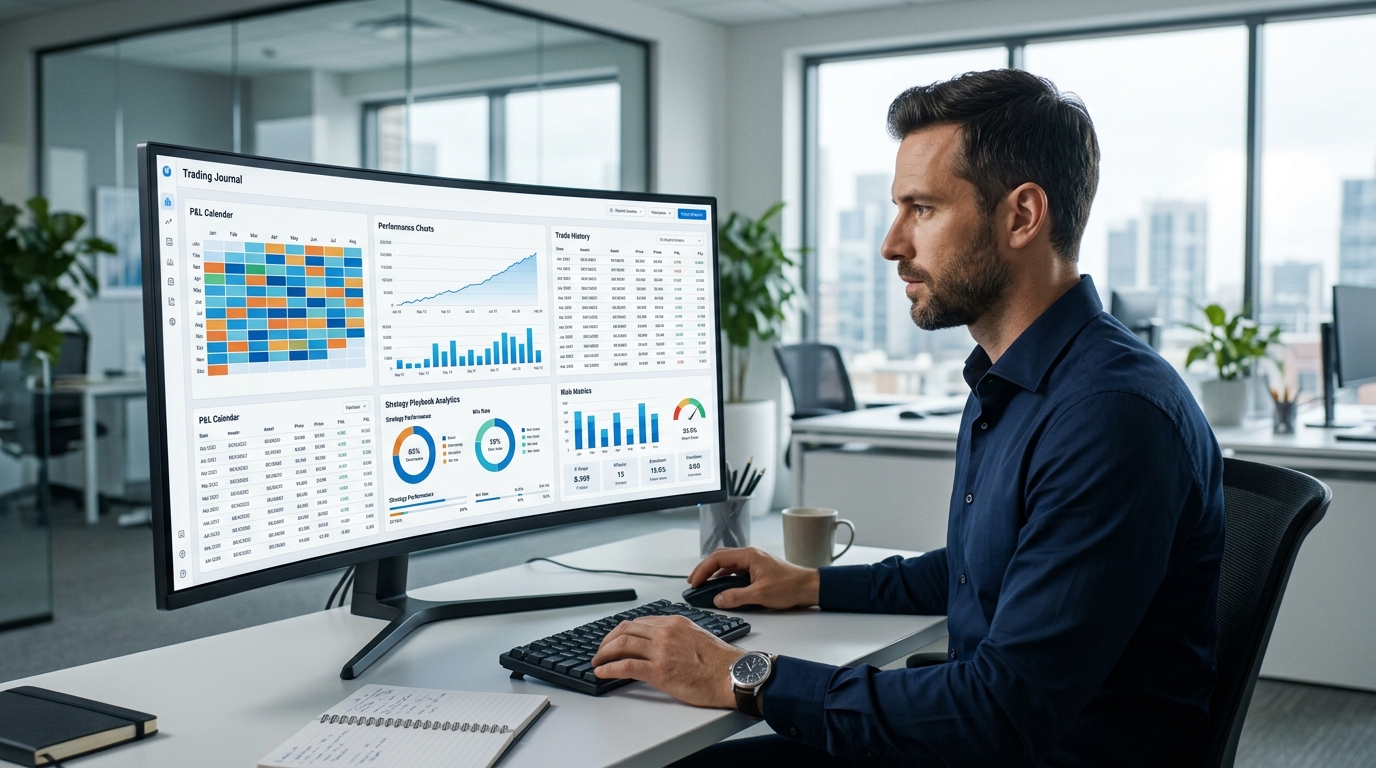
Tools built for this purpose can automatically organize trade history, calculate performance statistics, and generate visual P&L calendars without manual formula-building. Some platforms go further, analyzing risk metrics, surfacing psychology notes, and identifying behavior trends across dozens or hundreds of trades that would be nearly impossible to spot by scrolling through a spreadsheet.
It's worth being clear about what these tools actually do. A trading journal platform, including DailyTraderz, is built to help traders analyze their own behavior and historical performance. It does not generate trading signals, predict market direction, or provide financial advice. The value comes from self-awareness, not from outsourcing decision-making.
For traders weighing whether to stick with a manual spreadsheet or move to a more automated system, our comparison on Trading Journal Excel vs AI Trading Journal breaks down the practical differences in more detail.
Platforms like DailyTraderz combine the diary, the log, and the journal into one place, with features like AI psychology analysis, a progress dashboard, and discipline tracking, so traders can spend less time formatting spreadsheets and more time actually reviewing their decisions.
Common Trading Diary Mistakes
Keeping a diary is only useful if it's done consistently and honestly. A few mistakes tend to undermine the habit before it can produce any real benefit.
- Recording only losing trades: Winning trades taken outside your plan deserve just as much scrutiny, since they can reinforce bad habits if left unreviewed.
- Skipping emotional notes: Leaving out how you felt removes the most useful data point for identifying behavioral patterns.
- Not reviewing weekly: Logging trades without ever going back to review them defeats the purpose. A weekly review is where the actual learning happens.
- Ignoring risk metrics: Focusing only on win rate while ignoring risk-reward and position sizing gives an incomplete, sometimes misleading picture of performance.
- Being inconsistent: Journaling for two weeks and then stopping provides too small a sample to identify any real pattern in behavior.
Frequently Asked Questions
What is the difference between a trading diary and a trading journal?
A trading diary focuses on the emotional and behavioral side of trading, while a trading journal typically includes structured statistics and performance data. Most traders benefit from using both together.
How often should I update my trading diary?
Ideally after every trade, while the details and emotions are still fresh. Waiting until the end of the day or week often leads to inaccurate recall.
Do I need a trading diary if I already use a spreadsheet?
A spreadsheet can serve as your trading log, but unless it specifically includes fields for emotions and lessons learned, it's missing the diary component that supports behavioral improvement.
Can a trading diary improve my win rate?
A trading diary cannot guarantee improved results. What it can do is help you identify patterns and mistakes that, once corrected, may support more disciplined decision-making over time.
What should I write in the emotion fields?
Be specific. Instead of writing "nervous," note what caused it, such as "entered late and felt pressure to catch the move."
Is a digital trading diary better than a paper one?
Digital tools make it easier to search, filter, and analyze entries over time, especially as your trade history grows. Paper diaries work too, but lack automated statistics.
Do AI trading journal tools give trading advice?
No. Legitimate AI trading journal tools analyze your own historical behavior and statistics. They do not provide financial advice or predict future market movement.
How long before a trading diary shows useful patterns?
Most traders need at least 30 to 50 logged trades before meaningful patterns start to emerge in their behavior and statistics.
Should beginners keep a trading diary from day one?
Yes. Building the habit early, even with very few trades, makes it far easier to maintain consistently as trading volume increases.
What is the biggest benefit of keeping a trading diary?
The biggest benefit is self-awareness. A diary turns vague impressions about your trading into specific, reviewable evidence you can actually learn from.
If you're ready to bring your trading diary, log, and journal into one organized place, DailyTraderz offers a P&L calendar, risk tracking, and a progress dashboard designed to help you review your long-term performance more clearly.