Trading Journal Excel vs AI Trading Journal: Which Is Better in 2026?
Every serious trader eventually asks the same question: should I keep tracking my trades in a spreadsheet, or is it time to switch to something smarter? For years, Excel was the default answer. It was free, flexible, and every trader already knew how to use it. But in 2026, a new generation of AI-powered trading journals is changing what "keeping a trading journal" actually means.
This isn't a case of one tool being objectively better than the other in every situation. It's about matching the tool to how you trade, how much time you have, and what you actually want to learn about your own performance. Let's break it down properly.
Why Excel Became the Default Trading Journal
Excel earned its place as the go-to trading journal for a simple reason: it costs nothing to start and it does exactly what you tell it to do. If you already own a Microsoft 365 subscription, or use Google Sheets as a free alternative, you can build a working trading log in under an hour.
The appeal comes down to a few core strengths:
- Free: No subscription, no signup, no hidden cost. You open a blank sheet and start logging.
- Flexible: You control every column, every formula, and every layout decision. Want to track slippage in pips and add a custom column for "session"? You can.
- Familiar: Most traders already know the basics of spreadsheets from school or work, so there's no learning curve to get started.
- Custom formulas: With enough Excel knowledge, you can build win-rate calculators, risk-reward averages, and even basic equity curve charts.
These strengths are real, and for a beginner logging their first fifty trades, a simple spreadsheet is often the right starting point. The problem is that the same flexibility that makes Excel appealing on day one starts working against you as your trading matures.
The Hidden Problems of Spreadsheet Trading Journals
Spreadsheets are a tool built for static data, not for the kind of ongoing behavioral analysis that separates consistently profitable traders from the rest. A few months into using one, most traders run into the same set of frustrations.
Manual calculations
Every formula has to be built, tested, and maintained by hand. One broken cell reference or a wrong drag-fill on a formula, and your entire risk-reward column is quietly showing incorrect numbers without any warning.
Human error
Logging trades manually after a session means typos, missed entries, and inconsistent formatting are almost guaranteed over time. A single mistyped entry price can throw off your win rate calculations for weeks before you notice.
No psychology tracking
A spreadsheet can tell you what happened to your account balance. It cannot tell you why you broke your rules on Tuesday, revenge-traded after a loss on Thursday, or oversized a position because you were "confident." Trading psychology, arguably the single biggest factor in long-term profitability, is completely invisible in a normal spreadsheet.
No automated reports
Want a weekly performance summary or a breakdown of your best-performing setups? In Excel, that means building pivot tables and charts manually, every single time.
No behavioral insights
Spreadsheets store numbers. They don't recognize patterns like "you lose more often on trades taken after 2pm" or "your win rate drops significantly after two consecutive losses." Spotting these patterns requires manually reviewing dozens or hundreds of rows.
Limited scalability
A simple log works fine at 20 trades. At 500 trades across multiple strategies and instruments, most spreadsheets become slow, cluttered, and genuinely difficult to navigate.
None of this makes Excel a bad tool. It simply wasn't designed to analyze human behavior, only to store and calculate numbers you enter yourself.
What an AI Trading Journal Does Differently
An AI trading journal takes the raw data you'd normally type into a spreadsheet and does the analytical work automatically. It's important to be clear about what this means: the AI is not analyzing markets, predicting price movement, or suggesting trade entries. Its job is to analyze your habits, your statistics, and your behavioral tendencies as a trader.
Here's what that typically looks like in practice:
- Automatic analytics: Win rate, average risk-reward, profit factor, and expectancy are calculated instantly as trades are logged or synced.
- Risk tracking: Position sizing, risk per trade, and drawdown are monitored continuously, flagging when you're deviating from your own risk rules.
- Trading psychology: Some platforms, including DailyTraderz, use AI to detect emotional patterns in your trading history, such as revenge trading after losses or overtrading during winning streaks.
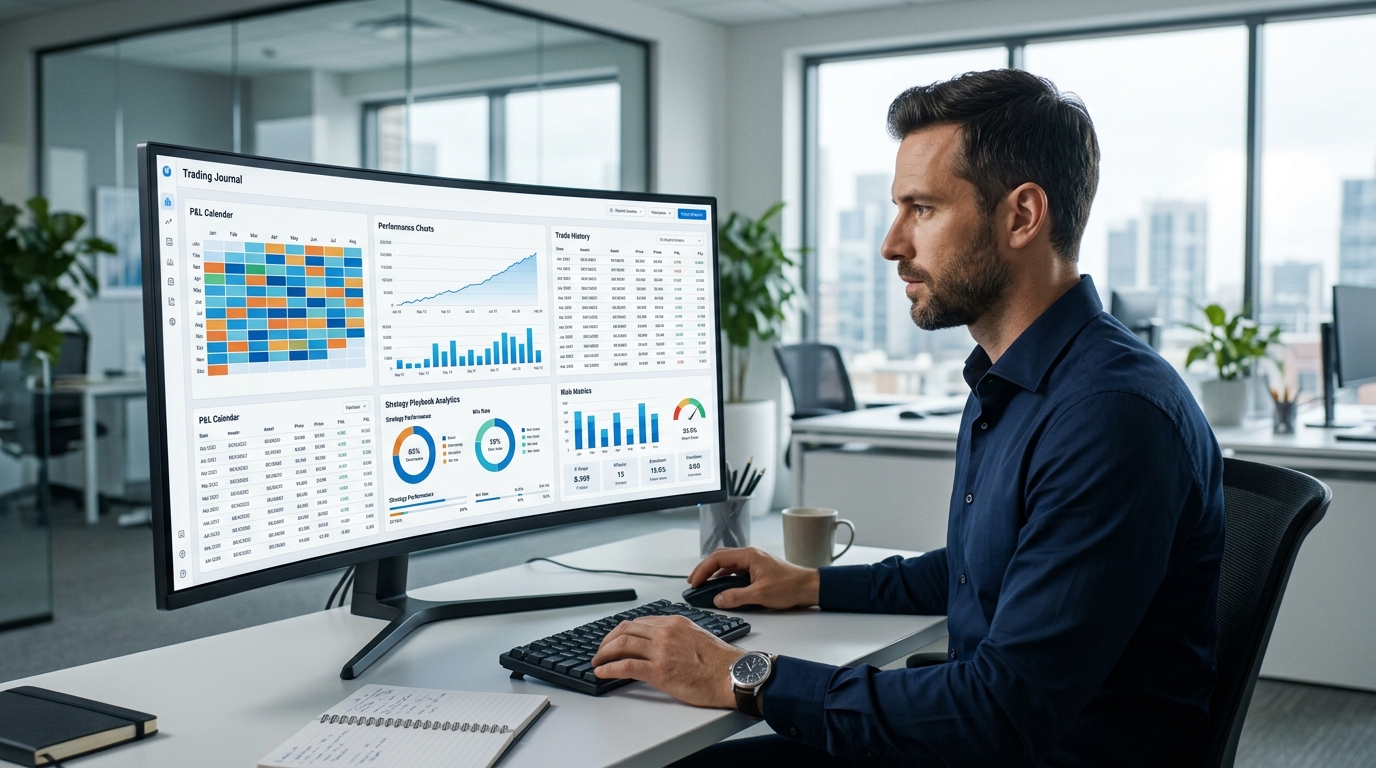
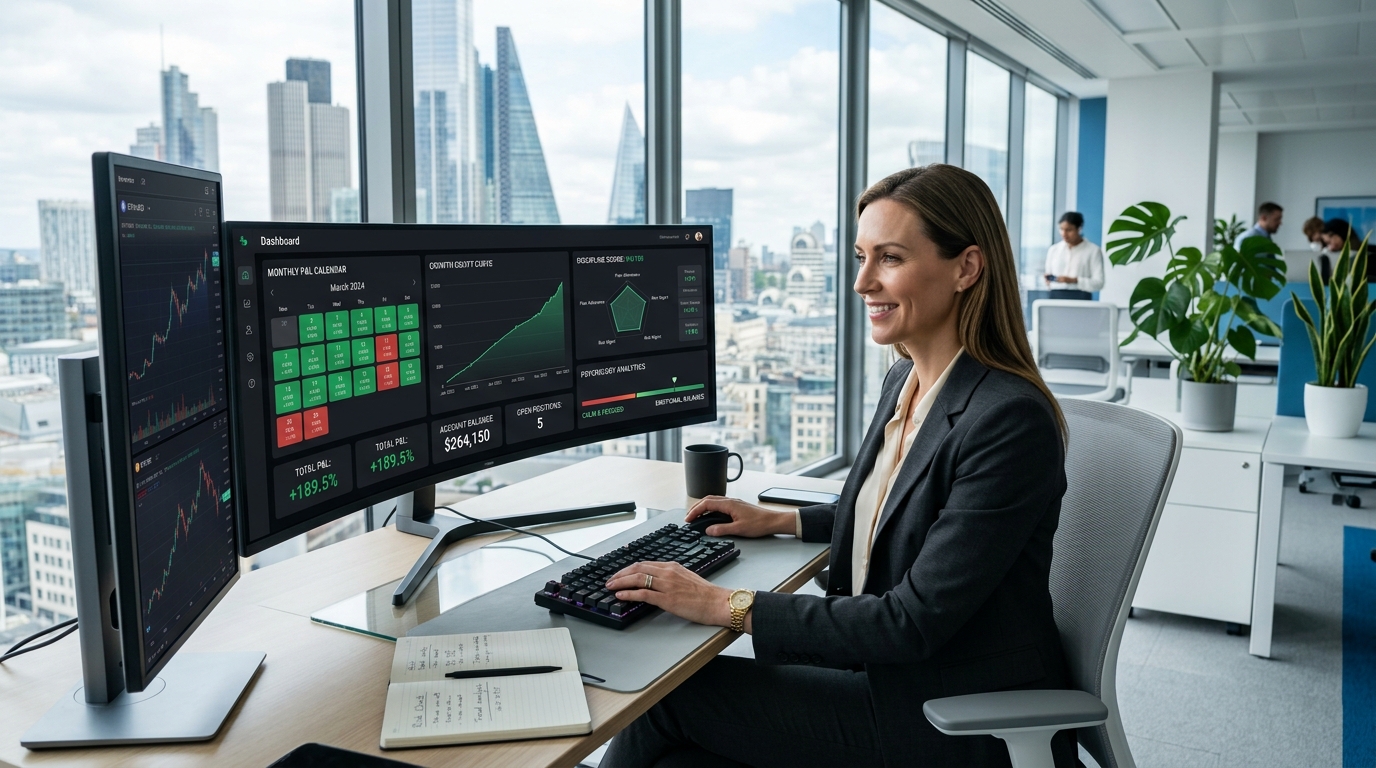
- P&L calendar: A visual calendar view shows profitable and losing days at a glance, making it easier to spot streaks and seasonal patterns.
- Performance dashboard: A single screen replaces dozens of manually built charts, showing your equity curve, win rate by setup, and performance by session.
- Behavioral pattern detection: The system identifies recurring habits, like consistently poor performance after a certain time of day or a tendency to close winners too early.
- Progress reports: Weekly or monthly summaries are generated automatically, giving a clear picture of whether your discipline and consistency are actually improving.
This distinction matters because trading psychology is widely recognized as one of the hardest things for traders to self-assess objectively. Educational resources on trading psychology and behavioral finance consistently point out that traders tend to underestimate how much emotion, not strategy, drives their losing streaks. An AI journal is essentially built to make that invisible pattern visible.
If you want a broader overview of the tools available in this space, our guide to the Best Trading Journal Apps covers several options beyond just DailyTraderz.
Feature Comparison Table
| Feature | Excel | AI Trading Journal |
|---|---|---|
| Trade Tracking | Manual entry required | Manual entry or auto-sync from broker |
| Charts | Built manually, time-consuming | Generated automatically |
| P&L Calendar | Not built-in, requires custom setup | Included by default |
| Risk Analysis | Formula-dependent, error-prone | Calculated and monitored automatically |
| Trading Psychology | Not tracked | Detected and reported |
| Behavior Tracking | Not available | Pattern recognition built-in |
| Reports | Manual, ad hoc | Automated, scheduled |
| Cloud Access | Depends on platform (OneDrive/Sheets) | Native cloud access on any device |
| Automation | Limited to formulas and macros | End-to-end automated analysis |
| Ease of Use | Requires spreadsheet skill to scale | Designed for traders, minimal setup |
Who Should Continue Using Excel?
Excel still makes sense in several situations, and there's no reason to abandon it just because newer tools exist.
- You're a beginner logging your first trades and want to understand the basics of tracking entries, exits, and outcomes without any subscription cost.
- You trade very infrequently, such as a handful of swing trades per month, where manual logging takes only a few minutes.
- You enjoy building your own custom formulas and want full control over exactly how your data is structured and displayed.
- You're testing a brand-new strategy on a small sample size and don't yet need psychology or behavioral analysis.
If any of these describe your current situation, a well-built spreadsheet is a perfectly reasonable choice. The key is recognizing when your needs outgrow it.
Who Should Upgrade to an AI Trading Journal?
As trading volume and complexity increase, the limitations of manual tracking become harder to ignore. Here's how the upgrade tends to benefit different types of traders:
Forex traders dealing with multiple currency pairs and session-based strategies benefit from automated session tracking and risk analysis that would otherwise require constant manual formula maintenance in a spreadsheet.
Crypto traders who trade around the clock across multiple exchanges gain the most from cloud access and automated syncing, since manually logging trades at 3am isn't realistic long-term.
Day traders placing several trades per session need real-time analytics and a P&L calendar to spot overtrading or emotional drawdown patterns before they spiral into bigger losses.
Swing traders benefit from progress reports and behavioral tracking that reveal whether patience and discipline are actually improving over weeks and months, not just individual trades.
Prop firm traders operating under strict risk rules rely heavily on automated risk tracking to avoid breaching daily loss limits or maximum drawdown thresholds, something a spreadsheet can't monitor in real time.
Platforms like DailyTraderz are built specifically around this shift, combining a P&L calendar, risk tracking, a progress dashboard, and AI-driven discipline tracking so traders can focus on execution instead of spreadsheet maintenance. The goal isn't to replace your trading strategy, it's to give you a clearer mirror of your own habits so you can improve faster.
Frequently Asked Questions
Is Excel still good for a trading journal in 2026?
Yes, especially for beginners or low-frequency traders. It's free and flexible, though it lacks automated psychology and behavioral tracking.
What is an AI trading journal?
An AI trading journal is software that automatically analyzes your trade history to surface statistics, risk patterns, and behavioral insights, without analyzing markets or predicting trades.
Does an AI trading journal give trade signals?
No. A genuine AI trading journal analyzes your habits and past performance, not market data or future price movement.
Can I track trading psychology in Excel?
Only manually, by adding notes or ratings for each trade. Excel cannot automatically detect emotional patterns like revenge trading or overtrading.
Is a trading journal app better than a spreadsheet for day trading?
For high-frequency trading like day trading, yes. Real-time analytics and automated risk tracking are far more practical than manual spreadsheet updates.
Are AI trading journals free?
Many offer a free tier or trial, with paid plans unlocking advanced features like full psychology tracking and automated reports.
What should a good trading journal include?
At minimum: trade entries and exits, risk-reward ratio, win rate, notes on setup and emotion, and some form of performance visualization like an equity curve or P&L calendar.
Can I switch from Excel to an AI trading journal without losing my data?
Most AI trading journals allow CSV import, so historical trades logged in Excel can typically be transferred over.
Is a forex trading journal different from a general trading journal?
Not structurally, but a forex-focused journal often adds session tracking, pip-based calculations, and currency pair correlation insights.
Which is more accurate: Excel or an AI trading journal?
An AI trading journal reduces the risk of manual calculation errors, since formulas and totals are generated automatically rather than built by hand.