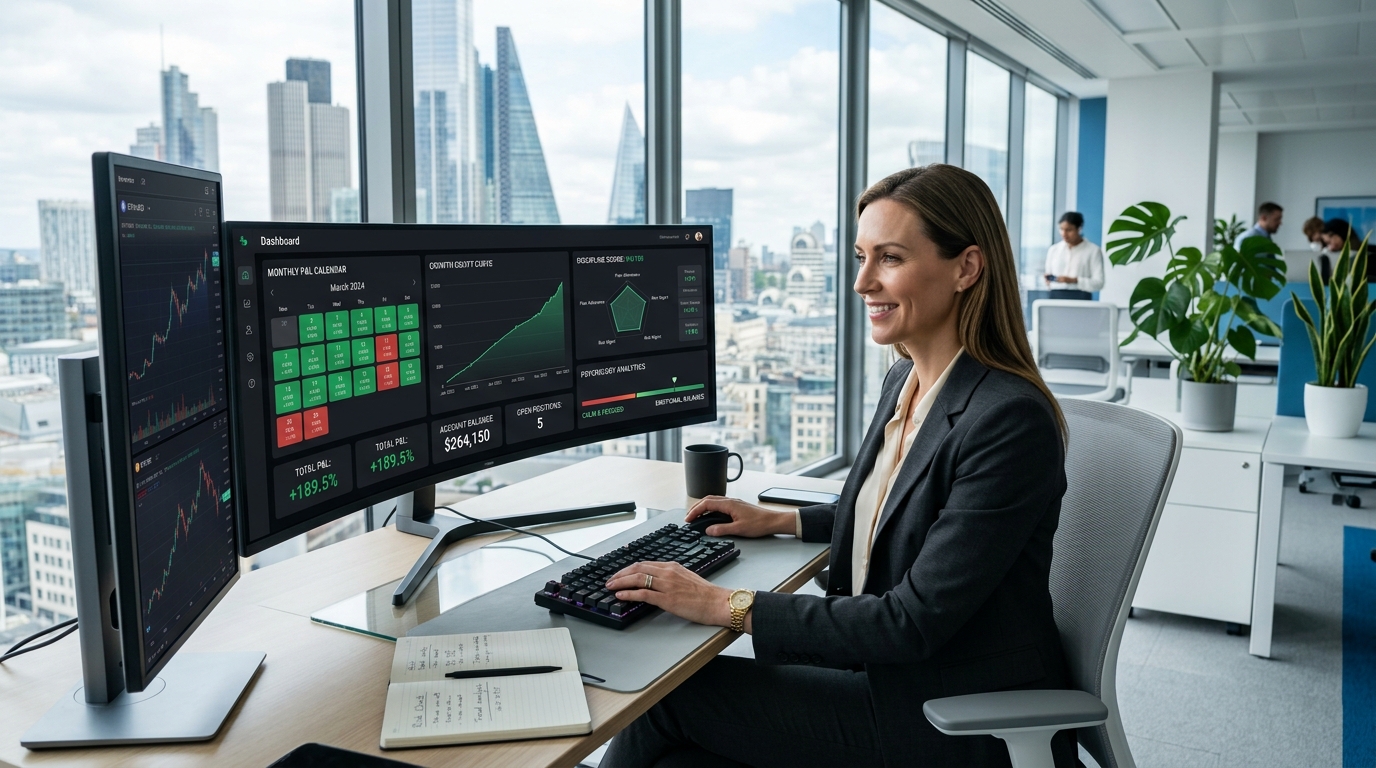
You don't need an expensive platform to start journaling your trades, and you shouldn't wait until you feel "serious enough" to begin. Whether you're placing your first few forex trades or you've been trading stocks for years, the habit of recording what you did and why matters far more than the tool you use to do it. A free trading journal is often the right place to start, regardless of experience level.
This guide walks through what a free trading journal actually is, the different formats available, where they fall short as your trading grows, and how to know when it's time to consider something more advanced.
What Is a Free Trading Journal?
A free trading journal is any no-cost method of recording your trades: entry, exit, size, result, and ideally some notes on your reasoning and emotional state. Its purpose is simple, to create a written record you can review later, instead of relying on memory alone.
The core benefit is accessibility. There's no financial barrier to starting the habit, which matters because the habit itself, not the specific tool, is what drives improvement. A free journal also tends to be flexible, since most free formats (spreadsheets, notebooks, basic apps) can be adapted to track whatever fields matter most to your strategy.
Common formats include paper notebooks, spreadsheet templates, free tiers of dedicated software, and simple web-based tools. Each comes with tradeoffs worth understanding before you commit to one.
Different Types of Free Trading Journals
Paper Journal
The most basic option. A physical notebook where you write down trade details and notes by hand. It requires zero setup and some traders find that handwriting notes improves recall and reflection. The obvious downside is that there's no way to calculate statistics automatically, and reviewing patterns across dozens of pages is slow.
Excel Spreadsheet
A step up in structure. Excel allows for custom columns, basic formulas, and simple charts. It's free if you already have a Microsoft 365 subscription, and widely familiar. The tradeoff is that every formula and chart has to be built and maintained manually, and a single broken cell reference can quietly throw off your calculations.
Google Sheets
Functionally similar to Excel, with the advantage of being genuinely free and accessible from any device with an internet connection. Cloud syncing makes it easier to update trades from a phone or laptop, though it shares the same manual formula limitations as Excel.
Web Apps
Some free web-based journals offer basic trade logging without the setup work of building your own spreadsheet. These tend to be more limited in customization than a spreadsheet but faster to get started with.
Trading Software Free Plans
Several dedicated trading journal platforms offer a free tier, typically with caps on trade volume, broker connections, or advanced analytics. These can be a reasonable way to test whether a more structured platform fits your workflow before considering a paid upgrade.
Advantages of Using a Free Trading Journal
- No financial commitment: There's no reason to delay journaling while waiting to afford software, since free options remove that barrier entirely.
- Builds the habit early: Starting with a free tool makes it easier to establish consistency before adding complexity.
- Flexible for beginners: Free formats can be adjusted easily as you figure out which fields and metrics actually matter to your strategy.
- Works for any market: Free journals can track forex, crypto, or stock trades equally well, since the underlying fields (entry, exit, risk, result) are similar across markets.
- Low pressure to formalize prematurely: Beginners can experiment with what to track and how, without committing to a specific paid platform's structure right away.
Limitations of Free Trading Journals
Free options are genuinely useful for getting started, but they come with real constraints that become more noticeable as trading activity increases.
Manual work
Every trade has to be entered by hand, and every statistic has to be calculated or built manually. This is manageable at low volume but becomes time-consuming as trade frequency increases.
No AI insights
Free journals generally don't analyze your behavior for patterns. Spotting a tendency like overtrading after a loss requires manually reviewing your own history.
Limited analytics
Basic win rate and profit/loss totals are usually achievable with formulas, but deeper metrics like R-multiples, MAE/MFE, or performance broken down by session typically require more advanced tools.
No psychology tracking
Most free formats don't have dedicated fields or structure for tracking emotional state, which means one of the most valuable layers of self-review is often skipped entirely.
Limited automation
Free journals rarely support broker auto-sync, meaning every trade must be manually transferred from your trading platform, which introduces the risk of typos and missed entries.
When Should Traders Upgrade?
There's no fixed rule for when to move beyond a free journal, but a few situations tend to make the case for upgrading clearer:
More trades: Once you're placing multiple trades per day, manual entry and formula maintenance start eating into time that could be spent on review instead.
Prop firms: Traders managing funded accounts often need to track daily loss limits and drawdown rules precisely, which automated risk tracking handles more reliably than manual spreadsheets.
Professional trading: As trading becomes a primary income source, the cost of a paid journal becomes easier to justify against the value of clearer, faster performance insight.
Performance analysis: If you find yourself wanting deeper statistics, like performance by setup or time of day, dedicated software calculates these automatically instead of requiring custom formula-building.
Behavior tracking: If emotional patterns are affecting your results and you want structured help identifying them, platforms with dedicated psychology and behavioral analysis features start to add real value. This kind of structured self-review is well supported in behavioral finance research, which links consistent, evidence-based reflection to more disciplined decision-making over time.
For a closer look at when the switch actually pays off, our comparison on Trading Journal Excel vs AI Trading Journal breaks down the practical differences in more depth, and our guide to the Automated Trading Journal covers what automation specifically changes about the process.
What Features Matter Most?
Whether you're comparing free tools or deciding if a paid upgrade is worth it, it helps to know which features actually move the needle for long-term improvement.
| Feature | Typically Free | Typically Paid |
|---|---|---|
| Trade History | Yes, manual entry | Yes, often with broker auto-sync |
| Performance Dashboard | Basic, manually built | Automated and detailed |
| P&L Calendar | Rarely included | Common feature |
| Risk Tracking | Formula-dependent | Automated monitoring |
| Trading Psychology | Manual notes only | Structured tracking, sometimes AI-assisted |
| Behavior Analysis | Not available | Pattern detection built-in |
| Trade Screenshots | Manual attachment | Often integrated directly |
| Cloud Access | Depends on platform | Standard feature |
| AI Insights | Not available | Increasingly common |
| Manual Entry | Yes | Usually still supported alongside automation |
| Reports | Manual, ad hoc | Automated, scheduled |
Platforms like DailyTraderz sit on the paid side of this comparison, combining a P&L calendar, risk tracking, and a performance dashboard with AI behavioral analysis aimed specifically at trading psychology and progress toward self-defined trading goals. It's worth being clear that this kind of AI analyzes your own trading behavior and history, not the market itself.
Frequently Asked Questions
Is a free trading journal good enough for beginners?
Yes. For traders just starting out, a free spreadsheet or paper journal is usually sufficient to build the habit and understand what data matters most.
What is the best free trading journal format?
It depends on preference. Spreadsheets offer the most flexibility, while free tiers of dedicated software offer more structure without manual formula work.
Can I track forex trades in a free trading journal?
Yes, forex trades can be logged in any free format, though you'll want to include pip-based risk and session timing as custom fields.
Do free trading journals track trading psychology?
Generally not in a structured way. Most free formats require you to manually add emotional notes, without any automated pattern detection.
When should I stop using a free trading journal?
There's no fixed threshold, but once manual entry and formula maintenance start taking meaningful time away from actual trade review, it's worth considering a paid alternative.
Are free trading journals accurate?
They can be, but accuracy depends entirely on manual entry and formula upkeep, which introduces more room for human error than automated systems.
Is Excel considered a free trading journal?
Yes, a spreadsheet is one of the most common free trading journal formats, provided you already have access to Excel or use Google Sheets instead.
Can a free trading journal help with risk management?
To some extent. You can manually track risk percentage and position size, though automated monitoring is generally more reliable at catching risk creep early.
Do I need AI features in a trading journal?
Not necessarily, especially early on. AI-driven behavioral analysis becomes more useful once you have enough trade history for patterns to become statistically meaningful.
What should I look for before upgrading from a free journal?
Consider whether you need automated broker sync, deeper analytics, or structured psychology tracking. Our roundup of the Best Trading Journal Apps covers several paid and free options side by side.
Starting with a free trading journal is a perfectly reasonable way to build the habit, and there's no need to overcomplicate things early on. When your trading volume grows or you find yourself wanting deeper analytics and behavioral insight, DailyTraderz offers a free trial with a P&L calendar, performance dashboard, and AI-powered trading psychology tracking built for that next stage.