Ask a trader why a losing streak turned into a serious account drawdown, and the honest answer is rarely "my entries were bad." More often, the real issue was trade size that didn't match the risk actually being taken. A perfectly reasonable strategy can still cause serious damage if position sizing is inconsistent or disconnected from stop-loss distance. This is exactly why position sizing, and the calculators built to handle it accurately, deserve far more attention than they typically get.
Position sizing is a core part of long-term risk management, arguably more important to survival in the markets than the entry signal itself. Getting it right, consistently, is what separates a strategy that can be evaluated fairly over time from one that gets derailed by a handful of oversized trades.
What Is a Position Size Calculator?
A position size calculator is a tool that determines the correct trade size, in lots, shares, or units, based on your account balance, chosen risk percentage, and stop-loss distance. Instead of guessing or using a fixed size for every trade, the calculator works backward from how much you're willing to lose to arrive at the exact size that keeps that risk consistent.
Purpose: The core purpose is consistency. Every trade should risk approximately the same percentage of the account, regardless of how far away the stop loss happens to be.
Benefits: A calculator removes guesswork, reduces the chance of accidentally over-risking a trade with a wide stop, and speeds up trade planning considerably.
Why manual calculations lead to mistakes: Doing this math by hand under time pressure, especially during a live trading session, introduces real risk of arithmetic errors, misplaced decimals, or simply skipping the calculation altogether and eyeballing a size instead.
How calculators improve consistency: By handling the calculation instantly and accurately, a calculator makes it realistic to size every single trade correctly, rather than only the ones where there's time to sit down and do the math carefully.
Why Position Sizing Matters
Capital preservation: Correct position sizing ensures no single trade can cause damage disproportionate to your overall risk plan, keeping you in the game for the long run.
Drawdown reduction: Consistent, controlled position sizes prevent a normal losing streak from turning into a severe drawdown that's difficult to recover from.
Consistency: When every trade risks a similar percentage of the account, your results become far easier to analyze and improve over time, since variance in outcomes reflects the strategy itself rather than inconsistent sizing.
Psychology: Trading a properly sized position tends to reduce emotional pressure, since the outcome of any single trade, win or lose, stays within a range you've already accepted in advance.
Long-term survival: Ultimately, position sizing is what allows a trader to survive long enough for a sound strategy's statistical edge, if one exists, to actually play out over a large sample of trades.
Key Variables Used in Position Size Calculations
A handful of core variables feed into every position size calculation. Understanding what each one does makes the math far less intimidating.
Account balance: The total capital in your trading account, used as the base for calculating risk percentage.
Risk percentage: The portion of your account you're willing to risk on a single trade, commonly somewhere between 0.5% and 2%, depending on your own risk management approach.
Entry price: The price at which you plan to open the trade.
Stop-loss distance: The distance, in price, pips, or points, between your entry and your stop-loss level.
Pip value: In forex, the monetary value of one pip of movement, which varies by currency pair and lot size.
Lot size: The standardized unit of trade size in forex, with standard, mini, and micro lots representing different quantities of the base currency.
Leverage: Where applicable, leverage affects the margin required to open a position, though it's worth noting that leverage itself doesn't change how much you should risk, it only changes how much capital is required to open the position.
A basic example: With a $10,000 account and 1% risk, your maximum dollar risk per trade is $100. If your stop loss is 25 pips away and each pip is worth $1 per micro lot on your chosen pair, you would calculate the position size that keeps a 25-pip stop-out equal to $100 in loss.
Position Sizing Examples
The core formula stays the same across markets, position size is calculated so that hitting your stop loss equals your intended dollar risk, but the specific units differ by asset class.
Forex
Suppose a trader has a $5,000 account and risks 1% per trade, or $50. Their stop loss on EUR/USD is 20 pips away. If a standard lot's pip value is approximately $10, a smaller lot size, such as 0.25 standard lots, would be calculated to keep the 20-pip stop-out close to the intended $50 risk.
Cryptocurrency
With a $5,000 account and the same 1% risk ($50), a trader planning a Bitcoin trade with a stop loss $500 away in price would calculate a position size (in this case, a fraction of a Bitcoin) such that a $500 adverse move results in approximately $50 of loss, accounting for the asset's price and typical volatility.
Stocks
For a $10,000 account risking 1% ($100), if a stock is trading at $50 with a stop loss set at $47 (a $3 risk per share), the position size would be calculated by dividing the $100 risk by the $3 per-share risk, resulting in an approximate share count that keeps total risk near $100.
Indices
Trading an index CFD or futures contract works similarly: with a defined point value per contract, a trader would calculate how many points their stop loss represents, then size the position so that a stop-out matches their intended dollar risk.
Gold
Gold (XAU/USD) is often traded in lots similar to forex, with a defined dollar value per pip movement. A trader risking $100 with a stop loss 300 pips away would size their position so that a 300-pip adverse move results in approximately $100 of loss, based on gold's specific pip value per lot.
Common Position Sizing Mistakes
- Risking too much: Sizing trades based on conviction or excitement rather than a predefined risk percentage, often without realizing how much of the account is actually exposed.
- Ignoring stop-loss distance: Using the same position size regardless of how far away the stop loss is, which causes wildly inconsistent risk from trade to trade.
- Increasing trade size after losses: Attempting to recover losses quickly by sizing up, which increases risk exactly when discipline matters most.
- Using maximum leverage: Treating available leverage as a target rather than a tool, which can expose far more capital to risk than intended.
- Trading emotionally: Adjusting position size in the moment based on confidence or frustration, rather than sticking to a calculated, predefined size.
Position Size Calculator vs Manual Calculations
| Category | Manual Calculation | Position Size Calculator |
|---|---|---|
| Speed | Slower, especially under time pressure | Instant results |
| Accuracy | Prone to arithmetic and decimal errors | Consistently accurate given correct inputs |
| Consistency | Depends on discipline to calculate every time | Removes the temptation to skip the step |
| Human Error | Higher risk, especially in fast-moving markets | Minimized through automation |
How AI Can Support Better Risk Management
Beyond basic calculation, AI-assisted tools have started to add a further layer of support around position sizing and risk management more broadly.
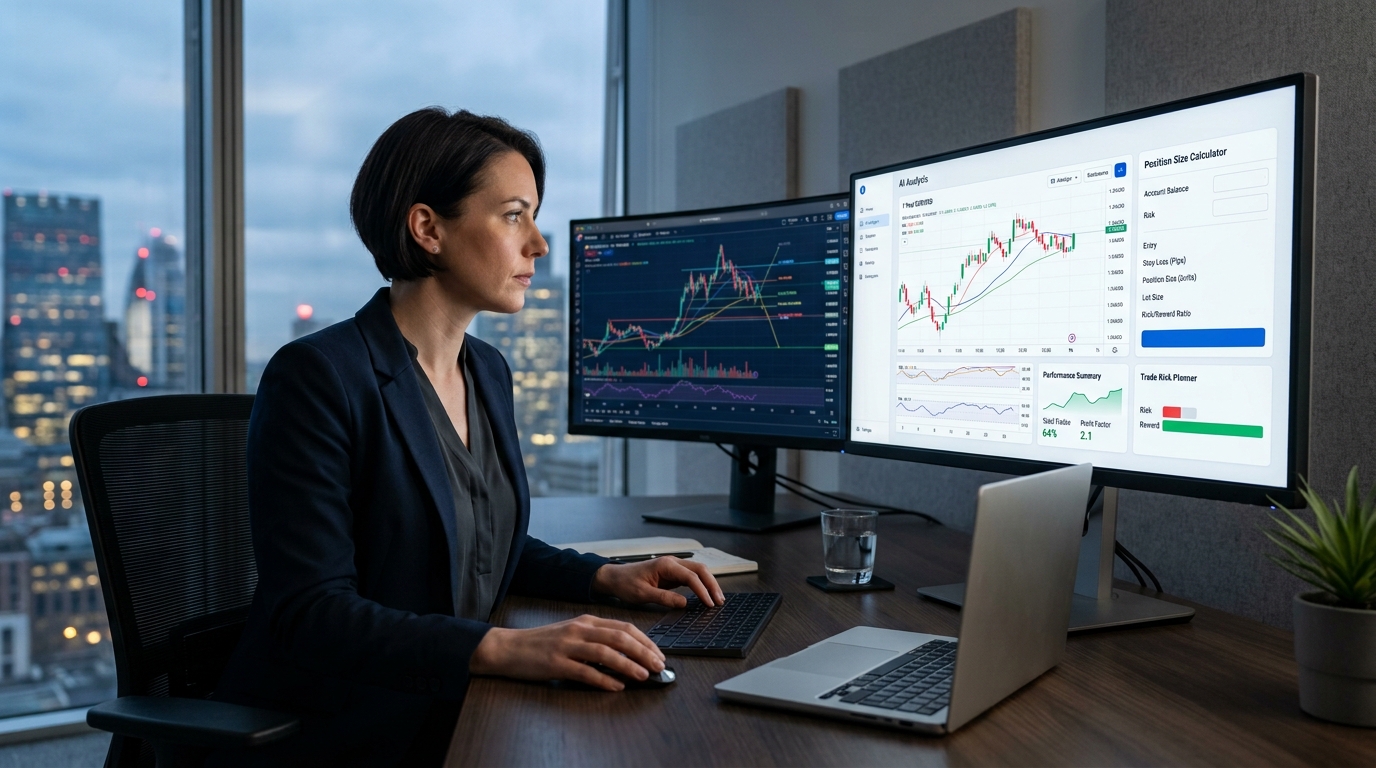
Trade Risk Planner tools combine account balance, risk percentage, and stop-loss distance into an automatic position size calculation before a trade is placed.
Position calculations update instantly as a trader adjusts entry or stop-loss levels during planning, avoiding the need to recalculate manually each time.
Risk consistency tracking monitors whether actual position sizes across trades match a trader's stated risk percentage over time, flagging drift early.
Historical analysis reviews past trades to show whether position sizing has been consistent, or whether it's crept upward after winning streaks.
Behavioral insights can highlight patterns like oversized positions following emotional trading periods, connecting risk data to psychology.
It's worth being clear about what this AI does and doesn't do: it calculates and tracks position sizing and risk based on a trader's own account and history. It does not generate trading signals, predict market direction, or provide financial advice.
How DailyTraderz Helps Traders Manage Position Size
DailyTraderz brings position sizing tools together with broader performance tracking. Its Trade Risk Planner, available on the Elite plan, calculates position size automatically based on account balance, risk percentage, and stop-loss distance, helping remove manual calculation errors before a trade is placed.
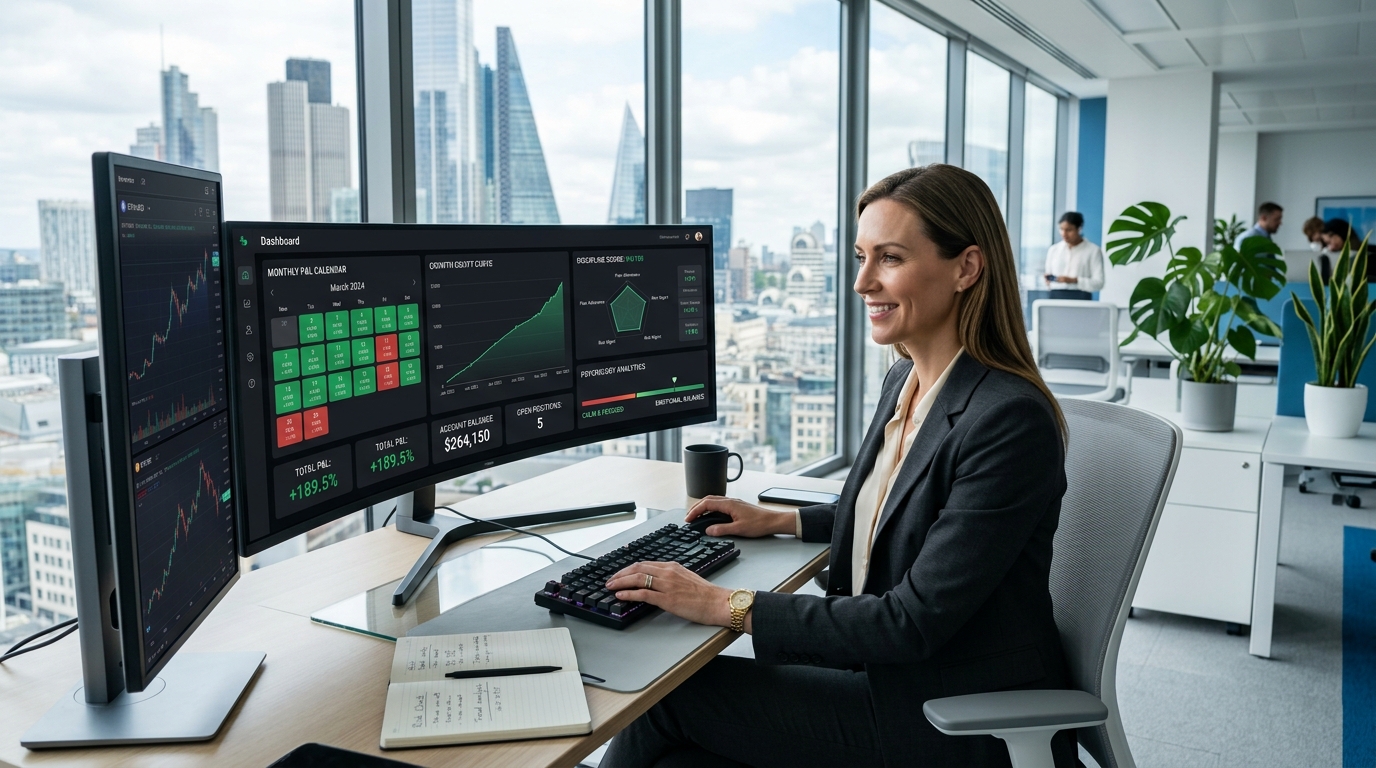
The platform's core Trading Journal and AI Analysis track risk consistency over time, while the Strategy Playbook and Asset Performance features allow position sizing data to be reviewed alongside strategy and instrument-level results. Goals and automated Reports help traders monitor whether actual position sizing matches their stated risk plan, and a P&L Calendar visualizes daily outcomes at a glance. As with any risk tool on the platform, the focus stays on supporting disciplined, consistent sizing decisions rather than predicting market direction.
Frequently Asked Questions
What is a position size calculator?
It's a tool that calculates the correct trade size based on your account balance, chosen risk percentage, and stop-loss distance, ensuring consistent risk across trades.
Why is position sizing more important than entry timing?
Even a well-timed entry can cause significant account damage if the position size doesn't match your intended risk, while proper sizing limits the impact of any single trade regardless of outcome.
What is the 1 percent risk rule?
It's a commonly referenced guideline suggesting a trader risk no more than 1% of their account balance on a single trade, though the appropriate figure varies by individual circumstances.
What is the 2 percent rule?
Similar to the 1% rule but risking twice as much per trade, allowing for potentially faster growth but requiring stricter discipline since losses compound more significantly.
How do I calculate lot size in forex?
Lot size is calculated by dividing your intended dollar risk by the product of your stop-loss distance in pips and the pip value for your chosen pair and lot size.
Does leverage affect how much I should risk?
Leverage affects the margin required to open a position, but your risk percentage should be based on your stop-loss distance and account balance, not on how much leverage is available.
Can I use a position size calculator for cryptocurrency?
Yes, the same core principle applies: calculating position size so that a stop-out matches your intended dollar risk, adjusted for the specific asset's price and volatility.
What happens if I don't use a position size calculator?
Without one, position sizes are often estimated or kept fixed regardless of stop-loss distance, leading to inconsistent risk from trade to trade.
Is a wider stop loss always riskier?
Not necessarily, since position size can be reduced to compensate for a wider stop, keeping dollar risk consistent regardless of stop distance.
How does position sizing relate to risk-reward ratio?
Position sizing determines how much is risked, while risk-reward ratio compares that risk to the potential reward, together forming a complete picture of a trade's risk profile.
Can AI tools replace manual position size calculations?
AI-assisted tools like a Trade Risk Planner can automate the calculation itself, reducing manual error, though the underlying inputs, account balance, risk percentage, and stop-loss distance, still come from the trader.
What's a common mistake traders make with position sizing after a loss?
Increasing position size to recover a loss quickly is one of the most common and damaging mistakes, since it increases risk exactly when discipline matters most.
Does position sizing differ between day trading and swing trading?
The core calculation is the same, though day traders often place more trades per session, making consistent sizing and a maximum daily loss limit especially important.
How often should I recalculate my position size?
Ideally before every single trade, since stop-loss distance and account balance can both change from one trade to the next.
Where can I learn more about broader risk management beyond position sizing?
Our guide on risk management for traders covers the full picture, including drawdown control, daily loss limits, and building a personal risk plan.
For traders looking to connect position sizing with ongoing trade review, our guide on the trading journal covers what to track across every trade, and our trading psychology journal guide looks at how emotional patterns often drive inconsistent sizing decisions. If you trade forex specifically, our forex trading journal guide covers pip-based risk tracking in more depth, and our crypto trading journal guide addresses the added volatility considerations specific to digital assets.
This kind of structured approach to position sizing and risk is consistent with educational resources from CME Group Education, risk disclosure guidance from the CFTC's Learn and Protect program, and investor education materials from FINRA, all of which emphasize disciplined, calculated risk-taking as a foundation of sound trading and investing practice.
Position sizing is one of the few parts of trading that's entirely within your control, regardless of how the market behaves. Getting the calculation right, consistently, on every single trade, is one of the most practical steps a trader can take toward long-term risk management. If you want to remove the manual guesswork, DailyTraderz's Elite Trade Risk Planner is built to calculate position size automatically, support disciplined risk management, and help you review your long-term trading performance in one place.