Most traders spend the majority of their time and energy searching for winning trades. Better entries, sharper indicators, more reliable setups. Far fewer spend that same energy on the one skill that actually determines whether they're still trading a year from now: protecting their capital. Risk management isn't the exciting part of trading, but it's the foundation everything else depends on.
A brilliant strategy with poor risk management can wipe out an account in a handful of bad trades. A mediocre strategy with disciplined risk management can survive long enough to actually be refined into something better. That asymmetry is why risk management deserves to come first, not as an afterthought once a strategy is already in place.
What Is Risk Management?
Risk management is the set of practices traders use to control how much capital is exposed to loss on any given trade, and across their account as a whole. It's built on a few core ideas.
Capital preservation is the underlying goal: staying in the game long enough for a sound strategy to play out over a large enough sample of trades.
Position sizing determines how much of your account is actually at risk on a single trade, based on your stop-loss distance and account balance.
Risk tolerance reflects how much drawdown or volatility a trader can handle, both financially and psychologically, without abandoning their plan.
Drawdown control involves setting limits on how much an account can lose before adjustments, like reducing position size or pausing trading, are triggered.
Consistency over short-term gains means prioritizing a repeatable process over chasing outsized results on any single trade, which tends to be far more sustainable over time.
Why Professional Traders Focus on Risk First
Professional traders and institutions tend to talk about risk before they talk about strategy, and for good reason.
Surviving losing streaks
Every strategy, even a statistically sound one, goes through losing streaks. Risk management is what determines whether a losing streak is a manageable dip or an account-ending event.
The role of discipline
Sticking to predefined risk rules, even during a stretch of losses or an especially tempting setup, is what separates disciplined execution from impulsive decision-making.
Managing expectations
Realistic risk management assumes losses are a normal part of trading, not a sign that something has gone wrong, which helps traders respond to losses rationally rather than emotionally.
Building consistency over time
A trader who risks a consistent, controlled amount per trade produces a much more analyzable, improvable track record than one whose risk varies wildly from trade to trade.
How Much Should You Risk Per Trade?
There's no single correct number that applies to every trader, but a few common frameworks are widely referenced as starting points for thinking about risk per trade.
The 0.5% rule: Risking half a percent of account equity per trade is a conservative approach often used by traders prioritizing capital preservation, or those managing larger accounts where even small percentages represent meaningful sums.
The 1% rule: Risking one percent per trade is a commonly referenced middle ground, allowing for a reasonable number of consecutive losses without severe account damage.
The 2% rule: Risking two percent per trade allows for potentially faster account growth but requires stricter discipline, since consecutive losses compound more significantly at this level.
Which level is appropriate depends on factors like trading experience, strategy win rate, average risk-reward ratio, and personal risk tolerance. A newer trader still refining their strategy's edge may reasonably choose a more conservative approach than an experienced trader with a longer, statistically validated track record. There's no universally "correct" answer here, and the right figure is something each trader needs to determine based on their own circumstances and, ideally, in consultation with their own research or a qualified professional.
Position Sizing Explained
Position sizing connects your risk percentage to an actual trade size, and understanding the relationship between the two is fundamental to consistent risk management.
The basic relationship involves three components: your account balance, the percentage of that balance you're willing to risk, and the distance between your entry price and your stop loss.
A simplified example: Suppose a trader has a $10,000 account and has decided to risk 1% per trade, or $100. If their stop loss is 50 pips away from their entry on a currency pair, they would calculate a position size where a 50-pip move equals approximately $100 of risk. This determines the lot size or number of units for that specific trade, rather than using the same fixed size regardless of stop distance.
The key principle is that position size should adjust based on stop-loss distance, not stay fixed. A trade with a tighter stop can support a larger position size for the same dollar risk, while a trade with a wider stop requires a smaller position size to keep risk consistent. Traders who use the same position size regardless of stop distance are, often unintentionally, risking wildly different amounts from trade to trade.
The Most Common Risk Management Mistakes
- Overleveraging: Using position sizes or leverage levels that expose far more of the account to a single trade than intended, often without fully realizing it.
- Moving stop losses: Shifting a stop further away mid-trade in the hope a losing position will recover, effectively increasing risk beyond what was originally planned.
- Increasing position size after losses: Attempting to recover losses quickly by sizing up, which increases risk exactly when discipline matters most.
- Ignoring maximum daily loss: Continuing to trade past a predefined daily loss limit, often compounding a bad day into a much worse one.
- Revenge trading: Entering trades impulsively after a loss specifically to win the money back, typically without the same risk discipline applied to the setup.
- No written risk plan: Trading without predefined rules for position sizing, maximum loss, and stop placement, which leaves risk decisions to be made emotionally in the moment.
How AI Can Improve Risk Planning
Calculating position size correctly for every single trade, especially across multiple instruments with different volatility profiles, takes time and is prone to manual error. This is an area where AI-assisted tools have become genuinely useful for risk management specifically.
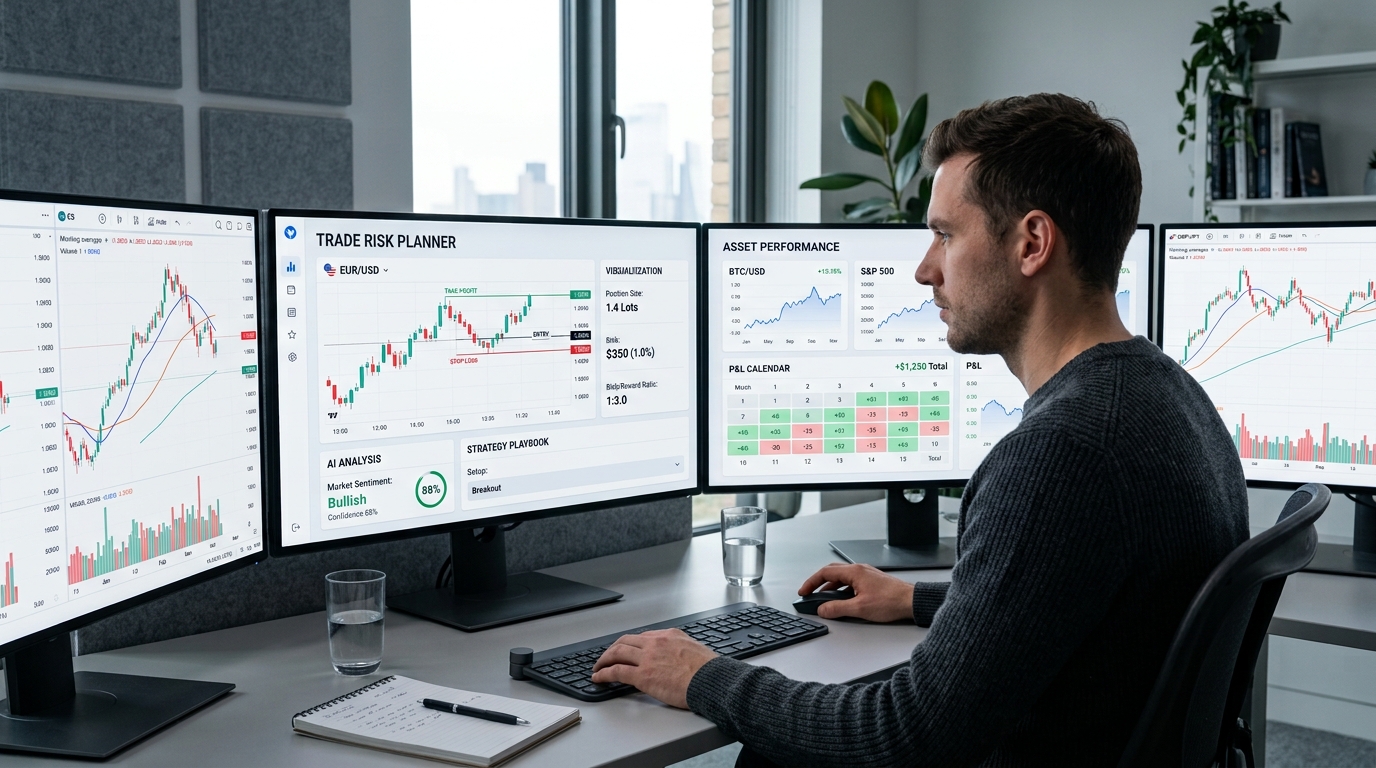
Trade Risk Planner tools calculate position size automatically based on account balance, risk percentage, and stop-loss distance, removing manual calculation error before a trade is even placed.
Automatic position calculations update in real time as stop-loss levels are adjusted during trade planning, rather than requiring the trader to recalculate manually each time.
Risk consistency tracking monitors whether actual risk taken per trade matches a trader's stated rules over time, flagging drift before it becomes a larger problem.
Behavioral analysis can surface patterns like position sizes gradually increasing after winning streaks, a common but often unnoticed risk management lapse.
Discipline reports summarize how consistently risk rules were followed across a given period, turning a vague impression into an actual trackable metric.
Historical performance reviews combine risk data with trade outcomes, helping traders see whether their risk-reward ratios are actually working in their favor over a large sample.
It's important to be clear about the boundary here: AI in this context supports decision-making around a trader's own risk parameters and history. It never predicts markets, and it doesn't tell a trader which direction an instrument will move. Its role is limited to calculation, consistency tracking, and historical analysis.
Building a Personal Risk Management Plan
A practical risk management plan doesn't need to be complicated, but it should be written down and specific. Here's a step-by-step framework traders can adapt to their own situation:
- Define your maximum risk per trade: Choose a specific percentage, such as 0.5%, 1%, or 2%, based on your experience level and account size, and commit to it in writing.
- Set a maximum daily loss limit: Decide in advance how much loss in a single day triggers a stop to trading for that session.
- Set a maximum drawdown threshold: Determine at what point a broader account drawdown would trigger a pause, a reduction in position size, or a full strategy review.
- Define your stop-loss approach: Decide how stops will be set, whether based on technical levels, volatility, or a fixed distance, and commit to honoring them once placed.
- Calculate position size before every trade: Use your risk percentage and stop-loss distance to determine size, rather than trading a fixed size regardless of the setup.
- Track your risk consistency: Log actual risk taken on every trade in a trading journal, and review it regularly to check for drift from your plan.
- Review and adjust periodically: Revisit your risk plan every few months, adjusting based on what your actual results and discipline data show, rather than emotional reactions to recent trades.
How DailyTraderz Supports Better Risk Management
DailyTraderz brings several of these risk management practices into one platform. Its Trade Risk Planner, available on the Elite plan, calculates position size automatically based on account balance, risk percentage, and stop-loss distance, helping remove manual calculation error before a trade is placed.
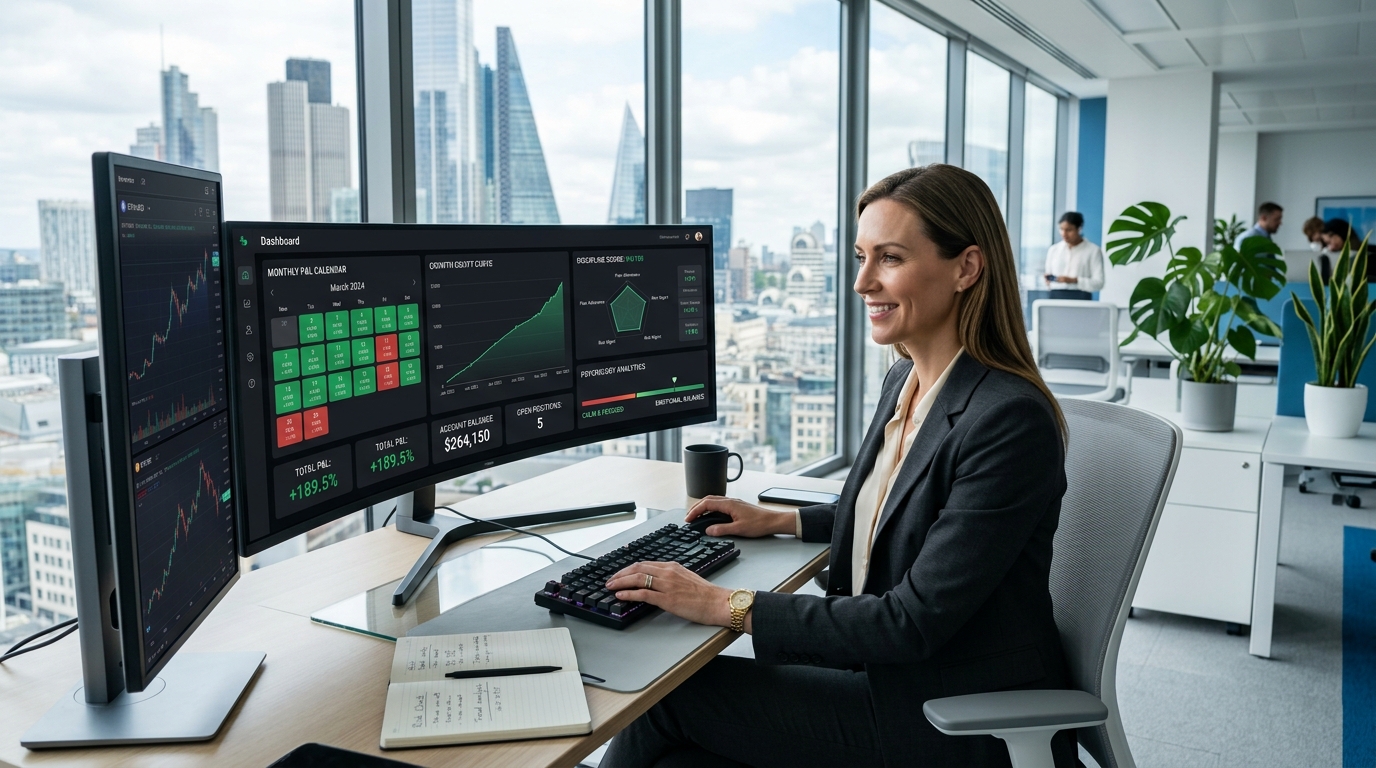
The platform's core Trading Journal and AI Analysis track risk consistency over time, while the Strategy Playbook and Asset Performance features allow risk data to be reviewed alongside strategy and instrument-level results. A P&L Calendar visualizes daily outcomes, and automated Reports and Goals help traders monitor whether their actual risk-taking matches their stated plan over weeks and months. The focus throughout stays on supporting disciplined decision-making, not on predicting market direction.
Frequently Asked Questions
What is risk management in trading?
It's the set of practices used to control how much capital is exposed to loss on any given trade and across an account as a whole, including position sizing, stop-loss placement, and drawdown limits.
How much should I risk per trade?
Common frameworks range from 0.5% to 2% of account equity per trade, though the right figure depends on your experience, strategy, and personal risk tolerance. This isn't a one-size-fits-all decision.
What is the 2% rule in trading?
It's a commonly referenced guideline suggesting a trader risk no more than 2% of their account balance on any single trade, though many traders use more conservative figures like 1% or 0.5%.
How do I calculate position size?
Position size is typically calculated using your account balance, chosen risk percentage, and the distance between your entry and stop-loss price, so that a stop-out results in your intended dollar risk.
Why do stop losses matter for risk management?
A stop loss defines the maximum you're willing to lose on a trade before it's even placed, which is what makes accurate position sizing and consistent risk possible.
What is drawdown and why does it matter?
Drawdown refers to the decline from a peak account value to a subsequent low. Tracking it helps traders understand worst-case scenarios and decide when adjustments to strategy or size may be warranted.
Is it ever appropriate to move a stop loss?
Moving a stop loss further away to avoid a loss generally undermines risk management, since it exposes more capital than originally planned. Some traders do adjust stops to lock in profit as a trade moves favorably, which is a different practice.
How does risk management differ for day traders versus swing traders?
Day traders often place more trades per session, making a maximum daily loss limit especially important, while swing traders may focus more on managing risk across fewer, longer-duration positions.
Can AI tools calculate position size for me?
Yes, tools like a Trade Risk Planner can automatically calculate position size based on your account balance, risk percentage, and stop-loss distance, reducing manual calculation errors.
What is risk-reward ratio and how does it relate to risk management?
Risk-reward ratio compares the potential loss on a trade to the potential gain. Combined with win rate, it helps determine whether a strategy's risk management approach is mathematically sound over time.
Does good risk management guarantee profitability?
No. Risk management cannot guarantee profits. It's designed to control losses and preserve capital, which supports long-term participation in the markets but doesn't eliminate the possibility of losses.
How can a trading journal support risk management?
Logging risk percentage and position size on every trade in a journal makes it possible to spot drift from your plan, such as gradually increasing size after wins. Our guides on the Day Trading Journal and Trading Journal App cover this in more depth, alongside our Trading Journal Software buyer's guide for comparing platforms.
Risk decisions are closely tied to psychology as well, since fear and overconfidence often drive the biggest deviations from a stated risk plan. Our guide on the trading psychology journal covers how to track and review that emotional side of risk-taking specifically.
This kind of structured, disciplined approach to risk is consistent with guidance from the FINRA Investor Education center, risk disclosure resources published by the CFTC's Learn and Protect program, and behavioral finance research from the CFA Institute, all of which emphasize capital preservation and disciplined risk practices as foundational to sound investing and trading.
Conclusion
Chasing high returns is what draws most people to trading, but consistent risk management is what actually determines whether a trader is still in the game long enough to benefit from a sound strategy. Protecting capital isn't the exciting part of trading, but it's the part that makes everything else possible. Traders who prioritize risk management first tend to build the kind of long-term consistency that chasing outsized wins rarely produces on its own.
If you're looking to bring structured risk planning into your trading process, DailyTraderz combines AI-powered journaling, performance analytics, and a Trade Risk Planner designed to help traders build disciplined, risk-aware habits over time.