Trade Review: How Professional Traders Analyze Every Trade to Improve Performance
Search for trading advice online and most of it focuses on finding something new, a fresh indicator, a different strategy, a sharper entry signal. Far less attention goes to reviewing trades that have already closed, even though that's where most professional traders actually spend a meaningful portion of their time. A disciplined trade review process tends to matter more for long-term improvement than constantly searching for the next new tool.
What Is a Trade Review?
A trade review is a structured process of analyzing a completed trade, examining not just whether it won or lost, but how it was executed, whether it matched a defined plan, and what can be learned from it.
Purpose: A trade review exists to extract useful, specific lessons from every trade, turning individual experiences into patterns that can actually improve future decisions.
Benefits: Consistent trade review builds a clearer picture of what's genuinely working, strengthens discipline, and reduces the chance of repeating the same mistakes indefinitely.
Reviewing versus checking profit/loss: Simply glancing at whether a trade made or lost money tells you almost nothing about the quality of the decision behind it. A trade review goes deeper, examining entry and exit quality, rule adherence, and psychological context, regardless of the final outcome. A well-executed trade can still lose, and a poorly executed one can still win, which is exactly why outcome alone isn't a reliable measure of decision quality.
Why Every Trader Should Review Every Trade
Continuous improvement: Specific, reviewable lessons accumulate over time into genuine skill development, far more than passive experience alone tends to produce.
Reducing repeated mistakes: A consistent review process makes recurring errors, like ignoring a stop-loss rule or entering on unconfirmed setups, much harder to overlook.
Building confidence: Reviewing a history of well-executed trades, regardless of individual outcomes, tends to build steadier confidence than chasing short-term results.
Improving execution: Comparing planned entries and exits against what actually happened reveals whether hesitation, slippage, or impulsiveness is affecting trade quality.
Strengthening discipline: Regularly checking trades against a defined plan reinforces the habit of following that plan in the first place.
The Complete Trade Review Checklist
A thorough trade review typically works through the same set of questions for every trade, regardless of outcome:
- Entry quality: Did the entry match the defined setup criteria, or was it taken early, late, or without full confirmation?
- Exit quality: Was the exit based on the original plan, or influenced by fear, greed, or impatience in the moment?
- Stop-loss placement: Was the stop set at a logical level before entering, and was it honored once the trade was live?
- Take-profit placement: Was the target realistic and based on the setup, or arbitrarily chosen?
- Risk percentage: Did the trade risk the intended percentage of the account, or was sizing inconsistent with the trading plan?
- Lot size: Was the position size correctly calculated based on the stop-loss distance and account risk?
- Market conditions: Was the broader market trending, ranging, or volatile, and did the strategy suit those conditions?
- Trading session: Which session did the trade occur in, and does that session tend to produce stronger or weaker results?
- Strategy followed: Did the trade match a specific, predefined strategy, or was it more of an improvised decision?
- Rule adherence: Overall, how closely did this trade follow the trader's written plan?
- Emotion before entry: What was the trader's confidence and stress level heading into the trade?
- Emotion during the trade: Did anxiety, excitement, or impatience influence any decisions while the position was open?
- Emotion after the trade: How did the outcome affect mood, and did that reaction influence the next trade taken?
- Screenshot analysis: Reviewing a saved chart image often reveals details about the setup that are easy to forget or misremember afterward.
- Lessons learned: A specific, actionable takeaway, even from trades that technically won.
Metrics to Evaluate During a Trade Review
Beyond individual trades, reviewing aggregated metrics regularly is where broader patterns become visible.
Win Rate: The percentage of trades closing profitably, useful mainly in combination with risk-reward rather than on its own.
Average RR: The typical risk-reward ratio across trades, helping determine whether a given win rate is actually sufficient.
Profit Factor: Gross profit divided by gross loss, providing a single figure reflecting overall trade quality.
Expectancy: A combined measure of win rate and average risk-reward estimating the average result per trade over a large sample.
Drawdown: The largest peak-to-trough decline in account value, useful for understanding worst-case scenarios.
Average Hold Time: How long trades typically stay open, revealing whether execution matches the intended trading style.
Best Strategy: Which tagged setup is genuinely producing the strongest results.
Worst Strategy: Which setup may need refinement or reconsideration.
Best Asset: Which instruments consistently produce stronger results.
Most Common Mistake: Identifying a single recurring error across trades, whether execution-based or psychological, gives a clear, specific focus for improvement.
Reviewing Winning Trades
It's tempting to only scrutinize losses, but winning trades deserve just as much attention. A win taken outside a defined strategy, on a setup that didn't actually meet the criteria, can reinforce a bad habit simply because it happened to work out. Reviewing winners specifically for rule adherence, not just outcome, prevents a trader from unconsciously learning the wrong lesson from a lucky result. It also helps confirm which parts of a strategy are genuinely reliable, rather than just occasionally profitable by chance.
Reviewing Losing Trades
Losses deserve a structured breakdown rather than a single vague reaction. A few specific categories tend to cover most losing trades:
Execution mistakes: Entering too early, exiting too late, or misreading the setup itself, independent of whether the underlying strategy was sound.
Psychological mistakes: Revenge trading, impatience, or fear-driven decisions that deviated from the plan.
Risk management issues: Position sizing that didn't match the intended risk percentage, or a stop loss that was moved or ignored.
Strategy failures: A properly executed trade, following the plan exactly, that still lost simply because markets don't guarantee any single outcome. This category is important to distinguish from the others, since a well-executed losing trade doesn't necessarily indicate a problem.
How AI Can Improve Trade Reviews
Working through this level of detail for every single trade, especially across a large trade history, takes real time. AI-assisted tools have become genuinely useful for handling this volume of review.
Behavior detection surfaces recurring tendencies, like weaker performance following consecutive losses.
Execution analysis compares planned entries and exits against actual behavior, highlighting gaps between intention and execution.
Psychology insights connect recorded emotional states to performance metrics, revealing whether certain moods correlate with weaker results.
Performance summaries translate raw statistics into plain-language overviews of what changed and what stayed consistent.
Strategy analysis aggregates results by tagged setup, showing which approaches are genuinely contributing to performance.
Asset Performance breaks down results by instrument, revealing which markets suit a trader's approach.
Weekly reports provide a consistent starting point for review, generated automatically rather than built manually.
Monthly reports help separate short-term variance from genuine, sustained shifts in performance.
It's essential to be direct about the limits here: AI in this context analyzes historical trading behavior only. It never predicts markets, and it never provides trading signals. Its entire role is helping traders see their own patterns more clearly.
Creating a Weekly Trade Review Routine
Daily review: A brief check on whether the day's trades followed the plan, without over-analyzing individual results in isolation.
Weekly review: A structured session covering the full checklist above, alongside win rate, risk-reward, and psychology notes for the week.
Monthly review: A broader look at strategy-level and asset-level performance, checking for trends not visible in a single week.
Quarterly review: An opportunity to step back and assess whether overall goals, risk tolerance, and strategy selection still match actual trading behavior and results.
How DailyTraderz Helps Traders Review Performance
DailyTraderz brings the components of a thorough trade review into one platform. Its core Trading Journal captures the detailed data, entries, exits, risk, screenshots, and psychology notes, needed for a complete review, while AI Analysis and an AI Coach feature summarize behavioral patterns and trends across a trader's history.
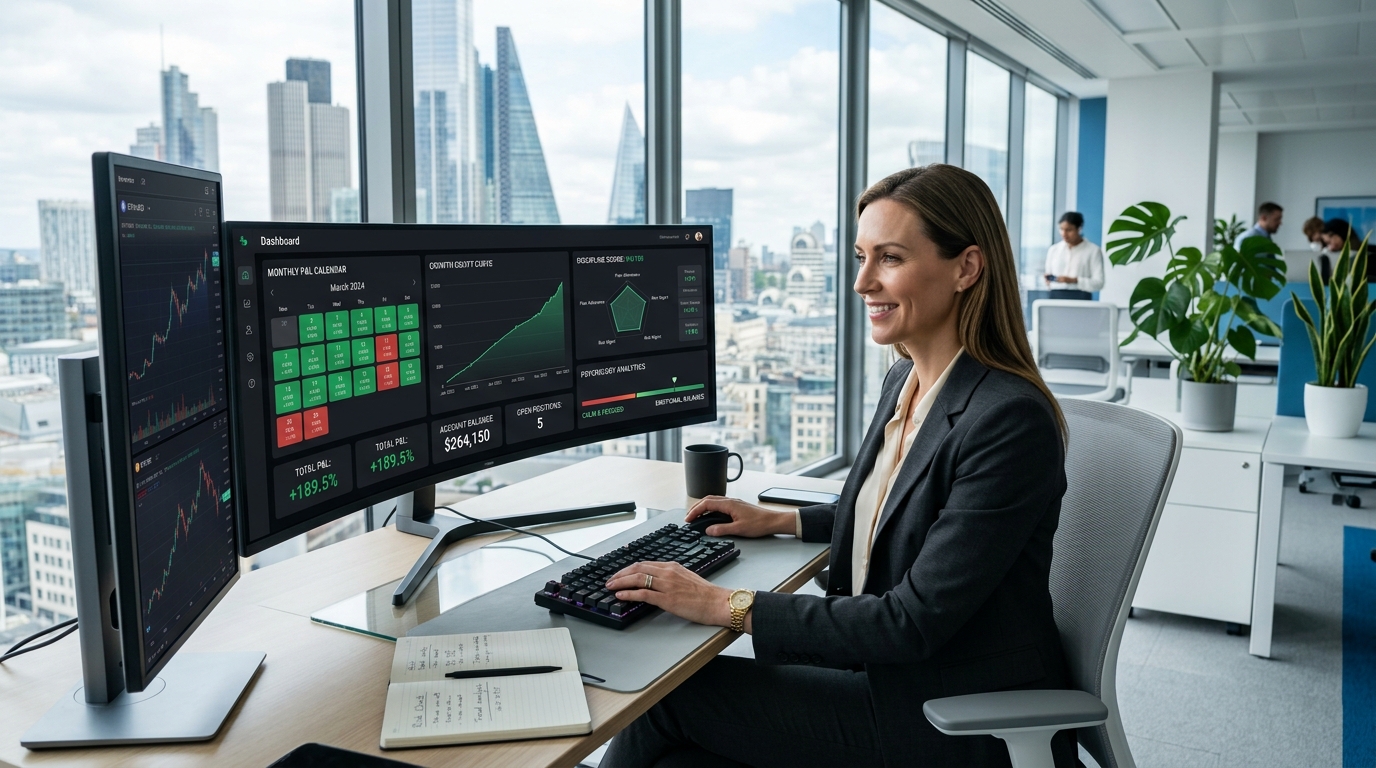
The Strategy Playbook allows performance to be reviewed at the setup level, and Asset Performance breaks results down by instrument. Its Elite plan includes a Trade Risk Planner for calculating position size and risk before entering a trade. Goals and automated Reports support ongoing review, alongside a P&L Calendar for visualizing daily results. Throughout, the platform's role stays limited to analyzing a trader's own historical performance, not predicting market direction or providing financial advice.
Frequently Asked Questions
What is a trade review?
It's a structured process of analyzing a completed trade, examining entry and exit quality, rule adherence, and psychological context, not just whether it won or lost.
Why is a trade review different from just checking profit and loss?
Profit and loss alone don't reveal decision quality. A well-executed trade can still lose, and a poorly executed one can still win, which is why deeper review matters.
How often should I do a trade review?
A combination of brief daily checks, structured weekly reviews, and broader monthly and quarterly reviews tends to provide the clearest picture over time.
Should I review winning trades, not just losing ones?
Yes. Wins taken outside your defined strategy can reinforce bad habits if they're never reviewed alongside losses.
What should be included in a trade review checklist?
Entry and exit quality, stop-loss and take-profit placement, risk percentage, market conditions, session, strategy followed, emotional state, and lessons learned.
Can AI help with trade reviews?
Yes, AI-assisted tools can analyze a trader's own historical trades for behavioral patterns and performance trends, though they don't predict markets or provide trading signals.
What is the difference between execution mistakes and strategy failures?
An execution mistake means the trade wasn't taken according to plan. A strategy failure means the trade followed the plan exactly but still lost, which is a normal part of trading.
How do I identify psychological mistakes during a trade review?
By comparing recorded emotional state and confidence against actual decisions made, looking for patterns like entering impulsively after a loss.
What is expectancy and why does it matter in trade review?
Expectancy combines win rate and average risk-reward to estimate the average result per trade, giving a single figure that reflects overall trading edge.
Should I take screenshots for every trade I review?
Screenshots provide valuable visual context that's easy to forget or misremember over time, making them a useful part of a thorough review.
What is a common mistake traders make when reviewing losses?
Treating every loss as a mistake, rather than distinguishing between execution errors, psychological lapses, and trades that simply didn't work despite being well executed.
How detailed should a trade review be?
Detailed enough to reconstruct the reasoning behind the trade later, though the process shouldn't become so time-consuming that it discourages consistent review.
Can a trade review improve my trading results?
A trade review cannot guarantee improved results. It can help identify specific, correctable patterns that may support more disciplined execution over time.
What is the best way to track recurring mistakes?
Logging a specific "lesson learned" for every trade, then periodically reviewing those notes together, often reveals a recurring theme worth addressing directly.
Should forex traders review trades differently than stock traders?
The core review process is similar, though forex traders often add session and currency pair context, while stock traders may focus more on sector or earnings-related factors.
How does crypto trade review differ from other markets?
Crypto's typically higher volatility often makes risk management review, particularly position sizing and stop-loss discipline, an especially important part of the process.
Can beginners benefit from doing trade reviews?
Yes, building the habit early makes it easier to develop self-awareness and consistency before trading volume and complexity increase significantly.
What is a strategy review versus a trade review?
A trade review examines a single trade in detail, while a strategy review aggregates many trades tagged to the same setup to evaluate overall performance.
How long should a weekly trade review take?
It varies by trading volume, but a focused session working through the full checklist for the week's trades is generally more valuable than a rushed, surface-level glance.
Does reviewing trades help with trading discipline?
Yes, consistently comparing actual trades against a defined plan reinforces the habit of following that plan in the first place.
What is the most important part of a trade review?
There's no single most important element, but honestly assessing rule adherence and psychological state tends to reveal the most actionable insight over time.
Can trade review help with risk management specifically?
Yes, reviewing risk percentage and position sizing on every trade helps catch drift from a trader's stated risk plan before it compounds into a larger problem.
How do professional traders structure their trade reviews?
Typically through a combination of daily, weekly, monthly, and quarterly reviews, each covering a different level of detail and time horizon.
What tools can help automate the trade review process?
Trading journal software with automated reporting and AI-assisted behavioral analysis can significantly reduce the manual effort involved in a thorough review.
Is it normal for a well-executed trade to still lose?
Yes, this is a normal part of trading. No strategy wins every time, and distinguishing this from an actual execution mistake is an important part of fair self-review.
This kind of structured, evidence-based approach to reviewing decisions is consistent with investor education resources from the CFTC's Learn and Protect program, FINRA's investor education center, behavioral finance research from the CFA Institute, and educational materials from CME Group Education. For a closer look at the analytics side of this process, this complete guide to trading analytics software is also worth reading.
To go deeper on specific parts of this process, explore our Trading Journal guide, our Trading Performance Tracker guide, and our Trading Analytics Software guide. For forex-specific review, our Forex Trading Journal guide covers session and pair-level context, and our Trading Psychology Journal guide addresses the emotional side of review in more depth. Our Risk Management guide ties directly into the risk-related review points covered here. You can also learn more about DailyTraderz directly at dailytraderz.com, explore the platform's features, or review current pricing.
Conclusion
Consistent trade review is one of the most valuable habits a trader can develop, arguably more valuable than the search for a new strategy or indicator. Reviewing both winning and losing trades, honestly and consistently, helps identify patterns, strengthens discipline, and supports better decisions over time. DailyTraderz is built to simplify this process, combining historical analysis, performance insights, and psychology tracking in one platform, without ever providing financial advice or predicting where the market is headed next.