Best Forex Trading Journal App (2026): The Complete Guide for Serious Forex Traders
Successful forex traders don't rely on memory to know how EUR/USD trades performed last month versus GBP/USD, or whether their London session results consistently beat New York. They review hundreds of historical trades, systematically, using a dedicated app built for exactly that purpose. Memory fades and distorts, especially across the volume of trades an active forex trader accumulates. A forex trading journal app exists to replace that unreliable memory with an accurate, reviewable record.
What Is a Forex Trading Journal App?
Definition: A forex trading journal app is dedicated software for recording, organizing, and analyzing currency trades, built with forex-specific needs like pip-based risk, sessions, and currency pair breakdowns in mind.
Purpose: Its purpose is to turn raw forex trade history into structured, reviewable insight, replacing manual spreadsheet work with automated statistics and often deeper behavioral analysis.
Benefits: A dedicated app saves significant time compared to manual tracking, reduces pip and lot-size calculation errors, and often surfaces patterns, like session-specific performance differences, that would be difficult to spot manually.
Why Every Forex Trader Needs One
Performance improvement: Specific, tracked data turns a vague impression of "forex trading has been fine" into an actual, measurable picture broken down by pair, session, and strategy.
Discipline: Comparing tracked trades against a defined forex trading plan is one of the clearest ways to see whether rules are genuinely being followed.
Psychology: Recording confidence and emotional state alongside forex trades makes patterns like session-specific anxiety or overconfidence after a strong week visible.
Risk management: Logging risk percentage and lot size on every trade helps catch position sizing drift before it compounds into a larger problem.
Consistency: A journal app makes it realistic to track every trade consistently, rather than only the memorable ones.
Historical analysis: With enough logged trades, patterns become statistically meaningful rather than anecdotal, revealing genuine strengths and weaknesses.
What Information Should Forex Traders Record?
| Field | Why It Matters |
|---|---|
| Currency Pair | Identifies which pairs perform best with your strategy |
| Entry | Confirms actual entry versus planned entry |
| Exit | Records where the trade was actually closed |
| Stop Loss | Shows whether risk was defined before entering |
| Take Profit | Reveals whether targets were realistic and consistently used |
| Lot Size | Standard forex sizing metric for accurate risk calculation |
| Risk % | Tracks whether position sizing stayed within stated rules |
| RR Ratio | Standardizes results across trades regardless of position size |
| Session | Reveals which session (London, New York, Tokyo, Sydney) suits a trader's approach |
| Spread | Affects entry cost and can influence scalping and short-term strategy results |
| Swap | Relevant for trades held overnight, affecting total cost of a position |
| Trade Duration | Reveals whether execution matches the intended trading style |
| Screenshot | Provides visual context for reviewing setups later |
| Psychology | Captures emotional state and decision-making context |
| Lessons Learned | Converts each trade into a specific, actionable takeaway |
The Most Important Forex Trading Metrics
Win Rate: The percentage of trades closing profitably, most meaningful alongside risk-reward rather than in isolation.
Profit Factor: Gross profit divided by gross loss, reflecting overall trade quality.
Average RR: The typical risk-reward ratio across trades.
Average Win: The typical size of a winning trade in pips or dollar terms.
Average Loss: The typical size of a losing trade, useful alongside average win for assessing overall balance.
Expectancy: A combined measure of win rate and average risk-reward, estimating the average result per trade over a large sample.
Maximum Drawdown: The largest peak-to-trough decline in account value.
Best Currency Pair: Which pair consistently produces the strongest results, visible only with enough logged trades.
Worst Currency Pair: Equally useful for identifying pairs that may be worth deprioritizing.
Consistency Score: How closely actual trades match a trader's defined strategy and rules.
Psychology Score: A rating reflecting emotional stability and discipline across forex trades specifically.
A practical example: A trader might discover their EUR/USD results during the London session significantly outperform their XAU/USD trades during the New York session, information that's only visible once enough trades across both combinations have been logged and compared.
Common Forex Trading Journal Mistakes
- Recording only winners: Skipping losing trades, or trades taken outside the plan, gives an incomplete and overly optimistic picture of performance.
- Ignoring psychology: Leaving out emotional context removes one of the most useful indicators for identifying behavioral patterns specific to forex sessions and pairs.
- Skipping screenshots: Without visual records, it's harder to recall exactly what the chart looked like at entry, especially weeks later.
- Changing strategies constantly: Abandoning a forex strategy after a short losing streak, without enough data across sessions and pairs to know whether it's genuinely underperforming.
- Not reviewing trades: Logging trades without ever revisiting them defeats the purpose. The learning happens during review, not during entry.
AI and the Future of Forex Journaling
Behavior analysis reviews a forex trader's historical decisions for recurring tendencies, like weaker performance after consecutive losses on a specific pair.
Historical insights process a full trade history far faster than manual review, surfacing statistics automatically.
Pattern detection identifies trends across sessions, pairs, and strategies that would be difficult to notice manually.
Execution reviews compare planned entries and exits against actual behavior.
Psychology summaries translate emotional data into plain-language overviews of recurring themes.
Asset Performance breaks results down by currency pair, revealing which markets genuinely suit a trader's approach.
Strategy analysis aggregates results by tagged setup, showing which forex strategies are actually driving performance.
It's essential to state this plainly: AI in this context analyzes completed historical trades only. It never predicts forex prices, and it never generates trading signals. Any tool suggesting otherwise is describing something fundamentally different from journaling.
How DailyTraderz Helps Forex Traders
DailyTraderz is one platform built around this fuller definition of forex journaling. Its core Trading Journal captures the detailed data forex traders need, including session, pair, and lot size, while AI Analysis and an AI Coach feature summarize behavioral patterns and trends across a trader's history.
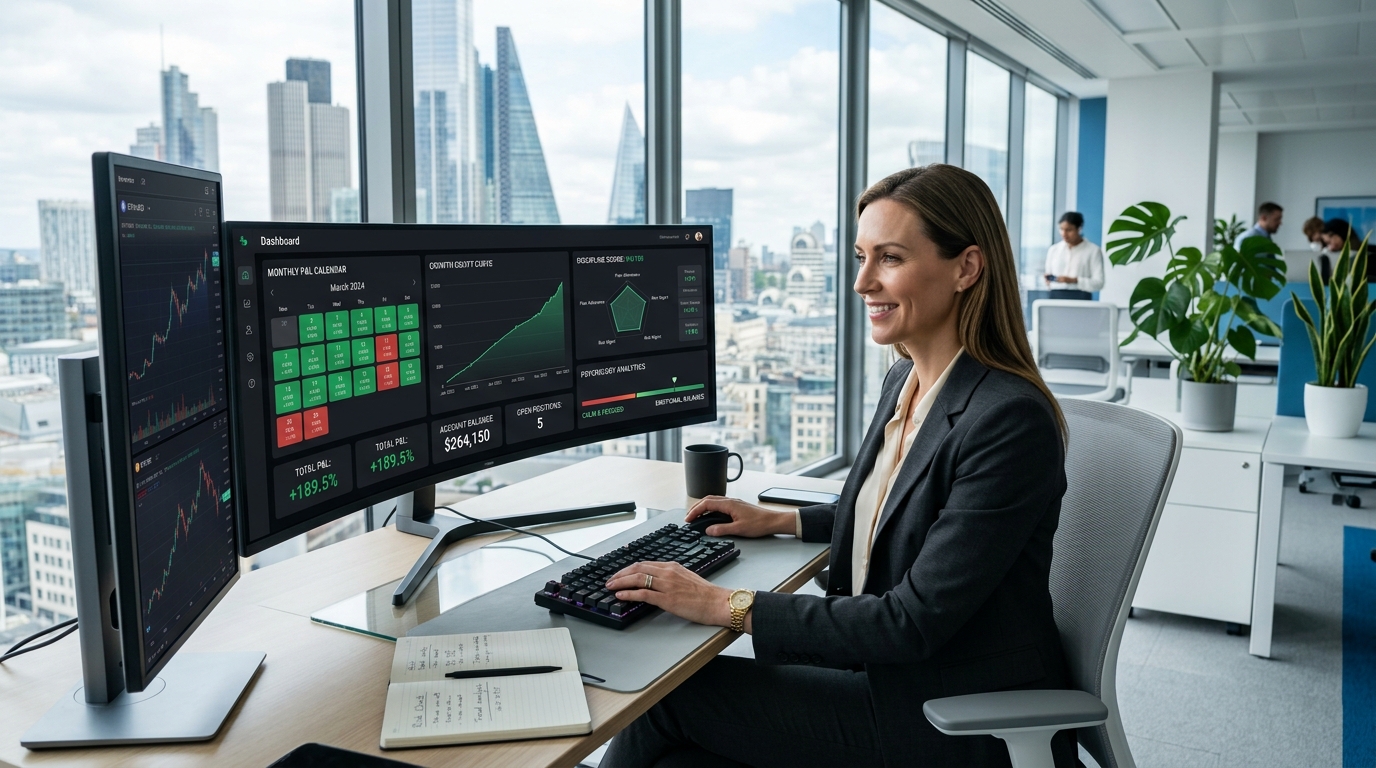
The Strategy Playbook allows trades to be tagged and reviewed by setup, and Asset Performance breaks results down by currency pair, whether that's EUR/USD, GBP/USD, or XAU/USD. Its Elite plan includes a Trade Risk Planner for calculating position size and risk before entering a trade. Goals, automated Reports, a P&L Calendar, and a Performance Dashboard round out the picture, giving forex traders a structured, centralized view of their historical performance. Throughout, the platform's role stays limited to analyzing a trader's own historical data, never providing financial advice or predicting currency movement.
Frequently Asked Questions
What is the best forex trading journal app?
There's no single best option for every trader. The right choice depends on trading volume, preferred currency pairs, and whether psychology and strategy tracking matter most to you.
Why do forex traders need a dedicated journal app?
A dedicated app handles pip-based risk calculations, session tracking, and currency pair breakdowns automatically, saving time and reducing manual errors.
What should I record for every forex trade?
At minimum: currency pair, entry, exit, risk percentage, session, strategy used, and a short note on emotional state and lessons learned.
How does a forex journal app calculate lot size?
By dividing intended dollar risk by the product of stop-loss distance in pips and pip value for the specific currency pair and lot size.
What is a good win rate for forex trading?
There's no universal "good" win rate, since a lower win rate can still be profitable with a strong average risk-reward ratio.
Does a forex trading journal app predict currency movement?
No. Legitimate forex trading journal apps analyze historical trading data. They don't predict currency prices or provide trading signals.
How does AI improve forex trade review?
AI can process a larger trade history faster than manual review, surfacing session, pair, and strategy patterns that would otherwise take significant time to identify.
Should I track spread and swap in my forex journal?
Yes, especially for scalping strategies where spread significantly affects results, or for trades held overnight where swap costs accumulate.
What is a Strategy Playbook in forex journaling?
It's a feature that allows trades to be tagged to specific strategies, enabling performance review at the setup level.
Is Excel good enough for forex trading journaling?
For lower trade volumes, a spreadsheet can work, though manual formula maintenance becomes limiting as trading frequency and the need for session-level analysis grow.
How do I track EUR/USD performance specifically?
Most forex journal apps allow filtering by currency pair, letting traders isolate and review EUR/USD results separately from other pairs.
How do I track GBP/USD performance specifically?
Similarly, filtering by pair in a journal app isolates GBP/USD trades for dedicated statistical review.
How do I track XAU/USD (gold) performance specifically?
Gold trades can be filtered and reviewed separately, useful since gold's volatility profile often differs meaningfully from major currency pairs.
What trading sessions should I track in my forex journal?
London, New York, Tokyo, and Sydney sessions are the standard breakdown, revealing whether certain sessions suit a trader's strategy better.
Can a forex journal app improve my results?
A journal app cannot guarantee improved results. It can help identify mistakes and patterns that, once corrected, may support more disciplined execution.
Should I journal forex trades that break even?
Yes, breakeven trades still provide useful information about execution and decision-making, even without a clear win or loss.
What is expectancy in forex trading?
Expectancy combines win rate and average risk-reward to estimate the average result per trade over a large sample.
How often should I review my forex trading journal?
A weekly review is generally recommended, with a broader monthly review to track longer-term trends across pairs and sessions.
What is a consistency score in forex journaling?
It's a metric reflecting how closely a trader's actual forex trades match their own defined strategy and rules.
Does a forex journal app work for both major and minor pairs?
Most platforms support any currency pair a trader logs, though liquidity and volatility differences between majors and minors are worth considering during analysis.
How detailed should my forex journal entries be?
Detailed enough to reconstruct your reasoning later, including entry, exit, risk, session, strategy, and emotional state.
Can AI detect forex-specific behavioral patterns?
Yes, AI-assisted analysis can identify patterns specific to sessions or pairs, like weaker discipline during the Asian session compared to London.
What is a Trade Risk Planner in forex trading?
It's a tool that calculates position size and risk before a trade is placed, based on account balance, risk percentage, and pip-based stop-loss distance.
Is a free forex trading journal app good enough for beginners?
For beginners logging a small number of trades, a free tier can be sufficient to build the habit before considering a paid upgrade.
How do I compare my performance across different forex sessions?
By logging the session for every trade and reviewing statistics filtered by that field, revealing which session produces the strongest results.
What is the difference between a forex trading journal and forex trading software?
A journal focuses specifically on recording and reviewing trades, while broader trading software may include charting or execution tools as well.
Can beginners benefit from AI-powered forex journaling tools?
Yes, though the benefit grows with trade volume, since AI-assisted pattern detection becomes more statistically meaningful with a larger sample of trades.
How does risk management tie into forex journaling?
Logging risk percentage and lot size on every trade helps catch position sizing drift before it compounds into a larger problem.
What is the biggest mistake new forex traders make in journaling?
Inconsistency is common, logging trades sporadically rather than for every single trade, which limits how meaningful the resulting statistics can be.
Can a forex journal app help identify overtrading?
Yes, tracking trade frequency by session and pair often reveals periods of overtrading that weren't obvious in the moment.
Should I use the same forex journal app across multiple broker accounts?
Many traders prefer this for a consolidated view, though it's worth checking whether the platform supports multiple account tracking specifically.
How does forex psychology tracking differ from general trading psychology?
The core concepts are similar, though forex-specific factors like session timing and overnight swap exposure can introduce unique psychological pressures.
What is maximum drawdown and why track it in forex trading?
Maximum drawdown reflects the largest decline from a peak account value, helping forex traders understand worst-case scenarios given typical currency volatility.
Can I import my MetaTrader history into a forex journal app?
Many platforms support CSV import or direct broker integration for MetaTrader-based accounts, though compatibility varies by platform.
Is journaling different for scalping versus swing trading in forex?
Scalpers often need to track spread more closely given the volume and speed of trades, while swing traders may focus more on overnight swap costs.
How do I know if my forex strategy is actually working?
A large enough sample of tracked trades, evaluated through win rate, expectancy, and consistency, provides a far more reliable answer than short-term results alone.
What features matter most in a forex trading journal app?
Session and pair-level tracking, automated risk calculations, psychology tracking, and AI-assisted pattern detection tend to matter most.
Can a forex journal app track multiple currency pairs simultaneously?
Yes, most platforms support any number of pairs, with filtering and breakdown tools to review each separately or in aggregate.
How does trade duration data help forex traders?
It reveals whether actual execution matches the intended trading style, useful for confirming whether a "swing" strategy is genuinely being held as planned.
Should I track economic news events in my forex journal?
Many traders find it useful to note whether a trade occurred around a high-impact news release, since volatility during these periods can significantly affect results.
What is the value of comparing best and worst currency pairs over time?
It reveals whether pair-specific performance is stable or shifting, informing decisions about where to focus strategy refinement and attention.
This kind of structured, evidence-based approach to forex journaling is consistent with investor education resources from the CFTC's Learn and Protect program, FINRA's investor education center, the National Futures Association's investor resources, and educational materials from CME Group Education.
To go deeper on specific parts of this process, explore our broader Forex Trading Journal guide, our Trading Journal Software buyer's guide, and our Trading Analytics Software guide. Our Trading Performance Tracker guide covers the metrics worth monitoring, our Risk Management guide covers position sizing principles in more depth, and our Trading Dashboard guide shows how to bring all of this forex data into one centralized view. You can also learn more about DailyTraderz directly at dailytraderz.com, explore the platform's features, or review current pricing.
Conclusion
Consistent forex trading is built through disciplined reviews, structured journaling, sound risk management, and continuous learning, not through predicting where a currency pair is headed next. The fields, metrics, and habits covered in this guide give serious forex traders a practical framework for turning scattered trade history into genuine, ongoing improvement. DailyTraderz is an AI-powered forex trading journal built to support that process, helping traders review historical performance and improve decision-making without ever providing financial advice or market predictions.