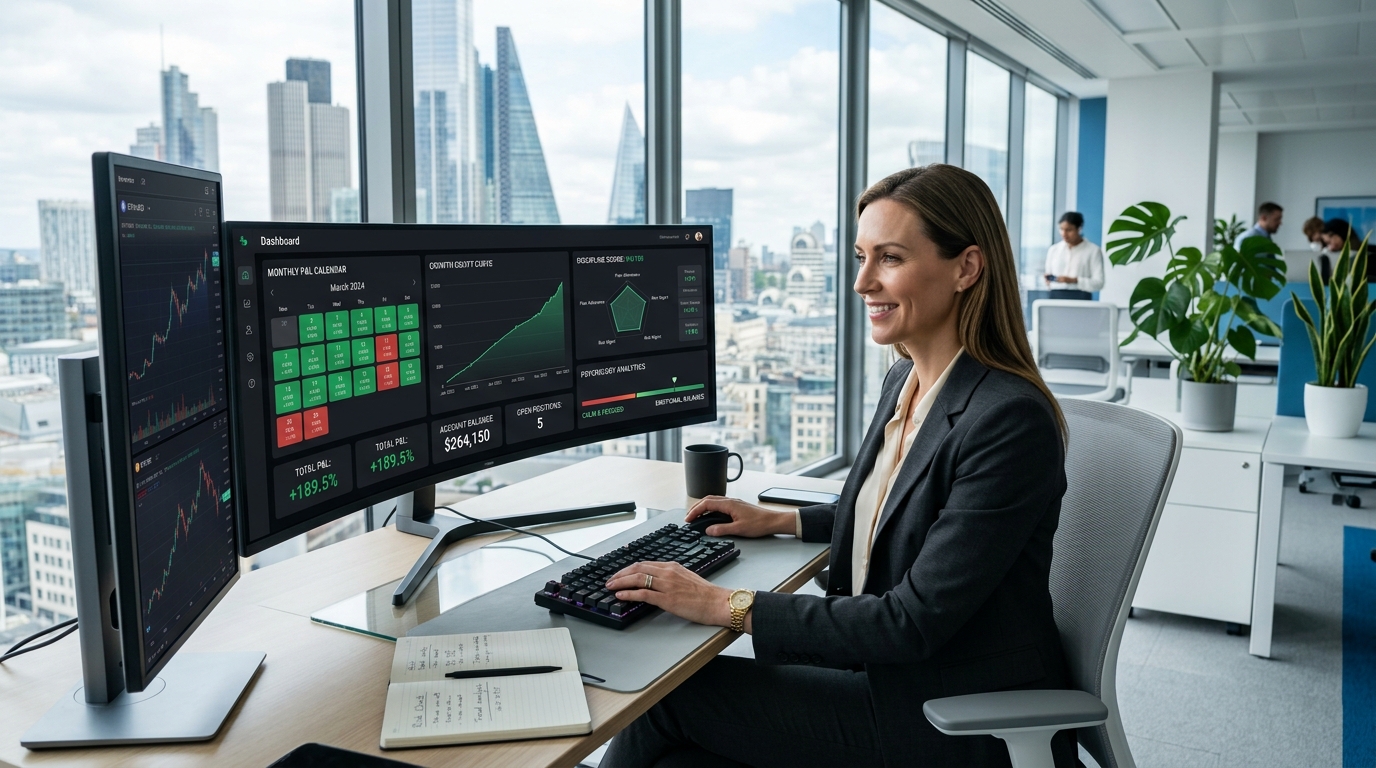
A few years ago, most traders logging their trades did so in a spreadsheet, and for many, that's still where they start. But a growing number of professional and serious retail traders have moved to dedicated trading journal software instead, not because spreadsheets stopped working entirely, but because analyzing historical performance thoroughly, tracking psychology, and reviewing strategy-level results at scale takes more than formulas and manual charts can practically deliver.
What Is Trading Journal Software?
Definition: Trading journal software is a dedicated platform for recording, organizing, and analyzing trades, built specifically for the needs of active traders rather than general-purpose spreadsheet tools.
Purpose: Its purpose is to turn raw trade data into structured, reviewable insight, covering everything from basic statistics to deeper behavioral and psychology analysis.
Benefits: Dedicated software saves significant time compared to manual spreadsheet work, reduces calculation errors, and often includes features, like AI-assisted behavioral analysis, that spreadsheets simply aren't built to handle.
Why Manual Journals Eventually Become Limiting
Excel limitations: Spreadsheets are flexible, but that flexibility comes at the cost of structure. As trade volume grows, spreadsheets become cluttered and harder to navigate.
Manual calculations: Every formula has to be built and maintained by hand, and a single broken cell reference can quietly throw off statistics for weeks before anyone notices.
Missed patterns: Spotting a behavioral tendency, like weaker performance after consecutive losses, requires manually reviewing dozens or hundreds of rows, something most traders don't have time to do thoroughly.
Reporting challenges: Weekly or monthly performance summaries have to be built from scratch each time in a spreadsheet, which many traders eventually stop doing simply due to the effort involved.
Time consumption: Manual entry and formula maintenance add up over time, taking hours that could otherwise be spent on actual trade review.
Essential Features Every Trading Journal Software Should Include
Trade Logging: The foundation of any platform, ideally supporting both manual entry and broker or CSV import.
Trade Screenshots: The ability to attach chart images to each trade, preserving visual context for later review.
Strategy Tracking: Tagging trades to specific setups, allowing performance to be reviewed at the strategy level rather than just across the whole account.
Asset Performance: Breaking down results by instrument or asset class, revealing which markets suit a trader's approach best.
Trading Dashboard: A centralized view summarizing win rate, risk-reward, and equity curve at a glance.
Trading Analytics: Automated calculation of deeper statistics like expectancy and profit factor, without manual formula work.
Trade Review: Structured tools for analyzing individual trades in depth, covering execution quality, risk adherence, and psychology.
Psychology Journal: Dedicated fields for tracking emotional state, confidence, and discipline alongside trade data.
AI Analysis: Automated review of a trader's own historical behavior, surfacing patterns that would be difficult to catch manually.
AI Coach: A feature that summarizes trends and highlights areas worth focused attention, based on a trader's own history.
Trade Risk Planner: Pre-trade calculation of position size and risk, supporting discipline at the decision point.
Goals: Tracking progress against specific, self-defined objectives, not just raw profit and loss.
Reports: Automated weekly or monthly summaries that make consistent review realistic without manual effort.
Performance Calendar: A visual calendar view that makes daily results easy to scan at a glance.
CSV Import & Export: The ability to bring in historical data from a spreadsheet, and export data out if needed.
Cloud Access: Availability across devices, so trade data isn't tied to a single computer.
Metrics Professional Traders Track
Win Rate: The percentage of trades closing profitably, most meaningful alongside risk-reward.
Profit Factor: Gross profit divided by gross loss, reflecting overall trade quality.
Average RR: The typical risk-reward ratio across trades.
Expectancy: A combined measure of win rate and average risk-reward, estimating average result per trade.
Largest Win: Reveals how much overall performance depends on outlier trades.
Largest Loss: Shows whether risk management held up in a worst-case scenario.
Maximum Drawdown: The largest peak-to-trough decline in account value.
Trade Frequency: How many trades are being taken over a given period, useful for spotting overtrading.
Average Hold Time: How long trades typically stay open, revealing whether execution matches the intended style.
Consistency Score: How closely actual trades match a trader's defined strategy and rules.
Psychology Score: A rating reflecting emotional stability and discipline across trades.
AI and Modern Trading Journal Software
Historical behavior analysis processes a full trade history far faster than manual review, surfacing statistics and trends automatically.
Pattern recognition identifies tendencies across a large trade history that would be difficult to notice manually.
Psychology summaries translate raw emotional data into plain-language overviews of recurring themes.
Execution reviews compare planned entries and exits against actual behavior.
Asset analysis breaks results down by instrument, revealing which markets suit a trader's approach.
Strategy analysis aggregates results by tagged setup, showing which approaches genuinely contribute to performance.
It's essential to be direct about the boundary here: AI in this context analyzes historical trading data only. It never predicts future prices, and it never generates buy or sell signals. Any platform framing its AI otherwise is describing something fundamentally different from journaling software.
Choosing the Right Trading Journal Software
Ease of use: A platform you'll actually use consistently matters more than one with every possible feature but a confusing interface.
Automation: Check whether trade import, calculations, and reports are handled automatically or require manual setup.
Charts: Look for visual breakdowns by strategy, session, or instrument, not just raw tables of numbers.
Analytics: Confirm the platform calculates deeper metrics like expectancy and consistency score, not just basic win rate.
Reports: Verify whether performance summaries are generated automatically on a regular schedule.
Security: Especially relevant if the software connects directly to a broker account through auto-sync.
Cloud synchronization: Useful for traders who want to log or review trades across multiple devices.
Import options: Check whether the platform supports CSV import and broker-specific integrations relevant to your trading.
Scalability: Confirm the platform can handle your trading volume without becoming slow or cluttered as your trade history grows.
Common Mistakes When Selecting Trading Software
- Choosing based only on price: The cheapest option isn't useful if it's missing features you'll actually need, like psychology tracking or strategy analysis.
- Ignoring reporting: A platform that stores data but doesn't summarize it clearly makes regular review harder than it needs to be.
- Ignoring psychology tools: Behavioral patterns are often a bigger factor in long-term results than most traders initially assume.
- Ignoring AI capabilities: Modern AI-assisted analysis can significantly reduce the manual effort involved in spotting behavioral patterns.
- Ignoring long-term scalability: A platform that works well at low trade volume may become cluttered or slow as trading activity increases.
How DailyTraderz Helps Traders Improve
DailyTraderz is one example of trading journal software built around this fuller definition of journaling. Its core Trading Journal supports manual entry alongside automated performance tracking, while AI Analysis and an AI Coach feature summarize behavioral patterns and trends across a trader's own history.
The Strategy Playbook allows trades to be tagged and reviewed by setup, and Asset Performance breaks results down by instrument. Its Elite plan includes a Trade Risk Planner for calculating position size and risk before entering a trade. Goals, automated Reports, a P&L Calendar, and a Performance Dashboard round out the picture, giving traders a structured, centralized view of their historical performance. Throughout, the platform's role stays limited to analyzing a trader's own historical data, never providing financial advice or predicting market direction.
Frequently Asked Questions
What is trading journal software?
It's a dedicated platform for recording, organizing, and analyzing trades, built specifically for active traders rather than general-purpose spreadsheet tools.
Why should I use trading journal software instead of Excel?
Dedicated software automates calculations, reduces errors, and often includes psychology and AI-assisted analysis that spreadsheets aren't built to handle.
What features matter most in trading journal software?
Trade logging, a performance dashboard, strategy tracking, psychology journaling, and automated reports tend to matter most for long-term improvement.
Does trading journal software predict market movement?
No. Legitimate trading journal software analyzes historical trading data. It doesn't predict future prices or generate buy or sell signals.
How does AI improve trading journal software?
AI can process a larger trade history faster than manual review, surfacing behavioral patterns and consistency issues that would otherwise take significant time to identify.
What is a Strategy Playbook in trading journal software?
It's a feature that lets traders tag trades to specific setups, enabling performance review at the strategy level.
Is there free trading journal software available?
Some platforms offer free tiers with limited features, which can be a reasonable way to test whether a structured platform fits your workflow.
How much does trading journal software typically cost?
Pricing varies widely across platforms, from free tiers to monthly subscriptions. It's worth comparing based on which specific features you'll use.
Can I import my spreadsheet data into trading journal software?
Most platforms support CSV import, making it possible to bring historical trade data over from an existing spreadsheet.
Does trading journal software work for forex trading?
Most modern platforms support forex alongside other asset classes, often including session and currency pair breakdowns.
Does trading journal software work for crypto trading?
Yes, many platforms support crypto exchanges, though it's worth checking specific compatibility and accounting for crypto's typically higher volatility.
Does trading journal software work for stock trading?
Yes, most platforms support stocks alongside other asset classes, often with broker import options for popular stock brokers.
What is a Trade Risk Planner?
It's a tool that calculates position size and risk before a trade is placed, based on account balance, risk percentage, and stop-loss distance.
What is expectancy and why should trading journal software calculate it?
Expectancy combines win rate and average risk-reward to estimate the average result per trade over a large sample, giving a single figure for overall trading edge.
How does psychology tracking work in trading journal software?
Most platforms include dedicated fields for confidence, emotional state, and rule adherence, sometimes with AI-assisted analysis of recorded patterns.
What is a consistency score?
It's a metric reflecting how closely a trader's actual trades match their own defined strategy and rules over a given period.
Is trading journal software suitable for beginners?
Yes, many platforms offer a simpler structure than building a spreadsheet from scratch, making it easier for beginners to start tracking consistently.
How do I choose between different trading journal software options?
Compare based on ease of use, automation, reporting depth, and whether psychology and strategy tracking are included.
What is a performance calendar in trading journal software?
It's a visual calendar view that displays daily profit and loss at a glance, making streaks and patterns easier to spot.
Can trading journal software help with risk management?
Yes, many platforms include automated risk tracking and position sizing tools that reduce manual calculation errors.
What is a Trading Dashboard in this context?
It's a centralized view summarizing key metrics like win rate, risk-reward, and equity curve, replacing manually built spreadsheet charts.
Does trading journal software support broker auto-sync?
Many platforms do, though broker compatibility varies, so it's worth checking support for your specific broker before relying on it.
What is an AI Coach feature in trading journal software?
It's a feature that summarizes trends and highlights areas worth focused attention, based on a trader's own historical data.
How secure is trading journal software?
Security practices vary by platform, so it's worth reviewing each provider's specific data protection measures, especially if broker auto-sync is used.
Can trading journal software scale with high trade volume?
Quality platforms are built to handle large trade histories without becoming slow or cluttered, unlike spreadsheets which often struggle at scale.
What's the difference between trade tracking software and trading journal software?
The terms are often used interchangeably, though "journal" sometimes implies a stronger emphasis on structured review and psychology tracking.
How does Asset Performance tracking work?
It breaks trading results down by specific instrument, revealing which markets a trader performs best or worst in.
What should I look for in trading journal software reports?
Automated, scheduled summaries covering win rate, risk-reward, and strategy performance tend to be most useful for consistent review.
Is cloud access important in trading journal software?
Yes, cloud access allows trade data to be reviewed and updated from any device, rather than being tied to a single computer.
Can trading journal software help identify overtrading?
Yes, tracking trade frequency over time, compared against a defined plan, often reveals periods of overtrading.
What is a Goals feature in trading journal software?
It allows traders to track progress against specific, self-defined objectives, which may be process-based rather than purely about profit.
How do I know if trading journal software is worth the cost?
Consider your trading frequency and which specific features, like psychology tracking or AI analysis, you'll actually use regularly.
Can switching trading journal software be difficult?
Most platforms support CSV export and import, making it relatively straightforward to move historical data between platforms.
Does trading journal software replace the need for a trading plan?
No, software tracks and analyzes execution, but a trading plan still needs to be created and followed separately.
What is the biggest advantage of AI-powered trading journal software?
The ability to process a large trade history quickly, surfacing behavioral and psychology patterns that would take significant manual effort to identify.
Should I prioritize features or price when choosing trading journal software?
Features that directly support your specific needs, like psychology tracking for behaviorally focused traders, generally matter more than price alone.
Can trading journal software help with strategy evaluation?
Yes, tagging trades to specific strategies and reviewing performance at that level reveals which approaches are genuinely working.
What is a Psychology Journal feature specifically?
It's a structured section for recording emotional state, confidence, and stress level alongside trade data, distinct from basic trade logging.
Do all trading journal software platforms include AI features?
No, AI capabilities vary significantly by platform, so it's worth confirming what specific AI analysis is included before choosing one.
How often should I use my trading journal software for review?
A weekly review is generally recommended, with a broader monthly review to track longer-term trends.
Is trading journal software useful for prop firm traders?
Yes, especially for tracking daily and maximum drawdown limits, which prop firm traders often need to monitor closely.
What's the best way to evaluate multiple trading journal software options?
Compare feature lists directly against your specific needs, trade volume, and preferred asset classes, rather than relying on marketing claims alone.
This kind of structured, evidence-based approach to evaluating and using trading software is consistent with investor education resources from the CFTC's Learn and Protect program, FINRA's investor education center, the National Futures Association's investor resources, and educational materials from CME Group Education.
To go deeper on specific parts of this process, explore our Trading Journal guide, our Trading Journal App guide, and our Trading Analytics Software guide. Our Trading Performance Tracker guide covers the metrics worth monitoring, and our Trade Review guide walks through evaluating individual trades in detail. You can also learn more about DailyTraderz directly at dailytraderz.com, explore the platform's features, or review current pricing.
Conclusion
The right trading journal software should help traders organize historical data, analyze performance, improve discipline, and make informed decisions based on past results, not chase predictions or shortcuts. The features, metrics, and evaluation criteria covered in this guide give traders a practical framework for comparing platforms and choosing one that genuinely fits their trading volume and priorities. DailyTraderz is one AI-powered option built around performance analysis, psychology tracking, and structured trade reviews, without ever providing financial advice or market predictions.