Ask most traders what a trading journal app does, and you'll usually get some version of "it's where I write down my entries and exits." That's not wrong, but it undersells what these tools have actually become. A modern trading journal app has evolved well beyond a digital notebook into a full performance analysis platform, one that tracks risk, surfaces behavioral patterns, and turns raw trade data into something you can actually act on.
Understanding that distinction matters, because choosing a trading journal app based only on "does it let me log trades" misses most of what separates a genuinely useful tool from a basic spreadsheet with a nicer interface.
What Is a Trading Journal App?
A trading journal app is software, typically cloud-based, designed to record, organize, and analyze your trading activity. At its core, it does what any journal does: capture entry, exit, size, and result for every trade. Where it goes further is in what happens after that data is captured.
Recording a trade is only the first step. The actual value comes from reviewing that data consistently, whether that's a weekly check on win rate and risk-reward, or an AI-assisted summary of behavioral patterns across the last hundred trades. A trading journal app that only stores data, without helping you make sense of it, isn't doing much more than a spreadsheet would.
Features Every Trading Journal App Should Include
Not every app in this category offers the same depth. Here's what tends to separate a genuinely useful trading journal app from a basic trade log:
Trade tracking: The foundation of any app, ideally supporting manual entry alongside CSV or broker import.
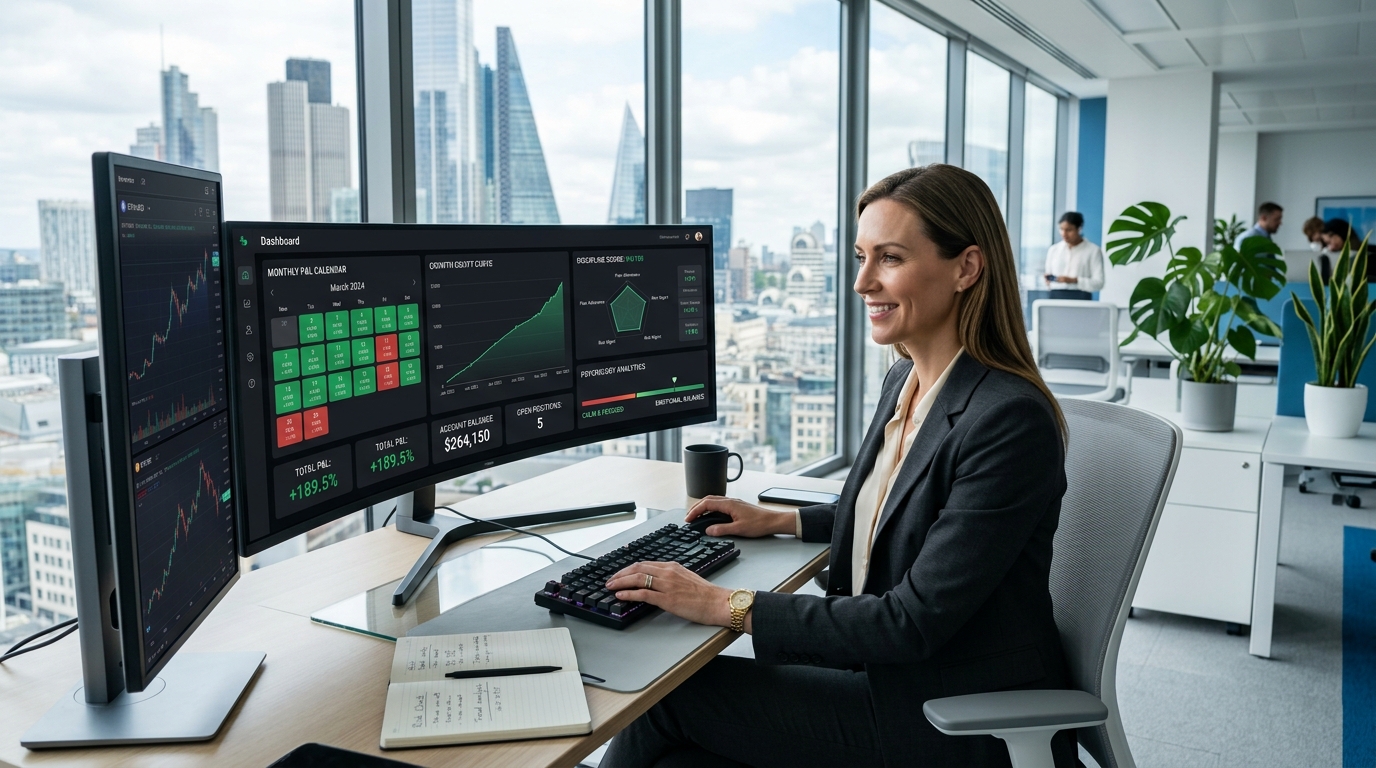
P&L Calendar: A visual calendar view that makes profitable and losing days easy to spot at a glance, without scrolling through rows of data.
Risk management: Automated tracking of position sizing and risk percentage, helping catch risk creep before it becomes a bigger problem.
Trading psychology notes: Structured fields for emotional state before and after trades, capturing the behavioral context that raw numbers miss.
Screenshot storage: The ability to attach chart images to each trade, preserving visual context for later review.
Performance analytics: Automated calculation of win rate, average risk-reward, and equity curve, updated as new trades are logged.
Strategy tracking: Tagging trades to specific setups, allowing performance to be reviewed at the strategy level rather than just across the whole account.
Asset Performance: Breaking down results by instrument or asset class, revealing which markets actually suit your approach best.
AI-powered reviews: Automated summaries that surface patterns in your own trading behavior across a larger sample than manual review would realistically cover.
Goal tracking: Measuring progress against specific, self-defined objectives rather than just raw profit and loss.
Trade Risk Planner: A tool for planning position size and risk before entering a trade, helping enforce discipline at the point of decision rather than only in hindsight.
Why Reviewing Trades Is More Valuable Than Recording Them
It's worth being direct about this: a trading journal app that's never actually reviewed provides almost no benefit, regardless of how much data it collects. The value is entirely in the review process.
Weekly reviews keep patterns fresh and catchable early, before a bad habit has a chance to compound over dozens of trades.
Monthly reports help separate short-term variance from genuine, sustained changes in performance, giving a clearer long-term view.
Behavior analysis reveals tendencies, like weaker performance during a specific session or after consecutive losses, that are nearly impossible to notice trade by trade.
Identifying recurring mistakes depends entirely on actually looking back at logged trades rather than assuming you remember what went wrong.
Building discipline comes from repeatedly comparing what you planned to do against what you actually did, a habit that only works if the review happens consistently.
The Role of AI in Modern Trading Journals
AI has become a meaningful part of how trading journal apps operate, but it's worth being precise about what it actually does. AI in this context is used to summarize trading habits across a large trade history, detect behavioral patterns like overtrading after a loss, identify recurring mistakes such as inconsistent position sizing, and help traders review their own decisions faster than manual analysis would allow.
What AI should never do, in a legitimate trading journal, is replace a trader's judgment or provide financial advice. It doesn't predict where the market is headed, and it doesn't tell you which trade to take next. Its role is limited to analyzing your own historical behavior, not the market itself. Any tool that blurs this line is doing something fundamentally different from journaling.
Choosing the Right Trading Journal App
With several platforms available, a few practical factors are worth evaluating before committing to one:
- Ease of use: A tool you'll actually use consistently matters more than one packed with features you'll never touch.
- Cloud access: Useful for reviewing performance across multiple devices, rather than being tied to a single computer.
- Mobile compatibility: Being able to log a trade or check a dashboard from a phone tends to support more consistent habit-building.
- Data visualization: Clear charts and dashboards make patterns easier to spot than raw tables of numbers.
- Reporting: Check whether performance summaries are generated automatically or require manual setup.
- Security: Especially relevant if the app connects directly to a broker account through auto-sync.
- Long-term progress tracking: Look for tools that show trends over months, not just a snapshot of recent trades.
- Customization: Confirm whether you can adjust fields, tags, and strategy categories to match how you actually trade.
How DailyTraderz Approaches Performance Analysis
DailyTraderz is one example of a cloud-based trading journal app built around this fuller definition of journaling, treating trade recording as the starting point rather than the whole picture. Its feature set includes AI Analysis for surfacing behavioral patterns, a Strategy Playbook for reviewing performance by setup, and Asset Performance breakdowns across different instruments.
On its higher-tier Elite plan, a Trade Risk Planner helps traders define position size and risk before entering a trade, rather than only reviewing risk after the fact. The platform also includes dedicated Trading Psychology tracking, a P&L Calendar for visualizing daily results, and automated Reports for regular performance review. As with any AI-assisted trading tool, it's worth being clear that this analysis is about the trader's own behavior and history, not a prediction of future market movement.
Frequently Asked Questions
What is a trading journal app used for?
It's used to record, organize, and analyze your trades, helping you review performance, risk management, and behavioral patterns over time rather than relying on memory alone.
Is a trading journal app better than a spreadsheet?
For active traders, generally yes, since automation reduces manual error and enables deeper analysis. For low-frequency traders, a spreadsheet may still be sufficient.
Do trading journal apps give trading signals?
No. Legitimate trading journal apps analyze your own historical trades and behavior. They don't predict market movement or provide financial advice.
What features matter most in a trading journal app?
Accurate trade tracking, a clear performance dashboard, risk management tools, and some form of psychology or strategy tracking tend to matter most for long-term improvement.
Can a trading journal app help with trading psychology?
Yes, many apps include dedicated fields or AI-assisted analysis for tracking emotional state and identifying behavioral patterns across your trade history.
What is a Strategy Playbook in a trading journal app?
It's a feature that lets traders tag trades to specific setups, enabling performance review at the strategy level rather than just across the whole account.
Is there a free trading journal app available?
Some platforms offer free tiers or trials with limited features. Our guide to the Free Trading Journal options covers what's realistic to expect at no cost.
Does a trading journal app work for Forex trading?
Most modern apps support Forex alongside other asset classes. Our deeper dive into the Forex trading journal covers session tracking, currency pair analysis, and other Forex-specific considerations.
Is TradeZella a good trading journal app?
TradeZella is a well-known option in this space with strong trade replay and analytics features. The right choice ultimately depends on which features, like psychology tracking or strategy playbooks, matter most to your workflow.
How do I choose between different trading journal apps?
Compare based on ease of use, cloud access, reporting depth, and whether psychology and strategy tracking are included. Our guides to Trading Journal Software, Trading Journal Online, and our roundup of the Best Trading Journal Apps all compare options in more depth, and our broader Trading Journal guide ties the full concept together.
For traders still deciding between manual and automated tracking, our comparison on Trading Journal Excel vs AI Trading Journal breaks down the practical tradeoffs. This kind of structured, disciplined record-keeping is also consistent with investor education guidance from organizations like the FINRA Investor Education resources, which emphasize risk awareness and consistent review as core habits for market participants.
Choosing a trading journal app isn't just about finding a place to log trades. It's about finding a tool that actually supports the review process, the part where real improvement happens. If discipline, psychology tracking, and long-term performance analysis are what you're looking for, DailyTraderz is worth exploring as a modern trading journal app built around exactly that.