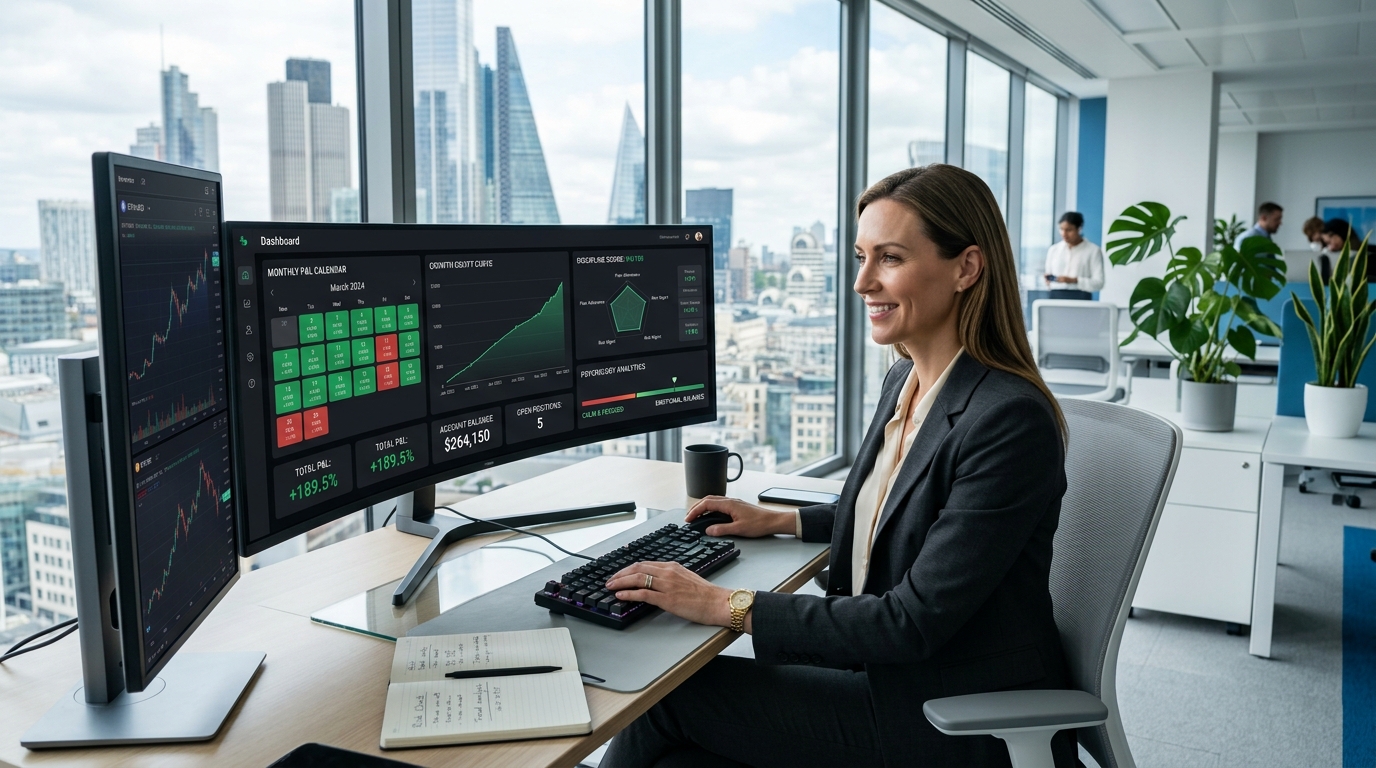
Day traders make dozens, sometimes hundreds, of decisions every month. Entries, exits, position sizing choices, moments where a stop loss gets moved or held. Without a written record of those decisions, it becomes almost impossible to identify recurring strengths and weaknesses, because there's simply too much happening too quickly for memory to hold onto reliably.
Successful day trading isn't built primarily on finding a better setup. It's built on review, discipline, and continuous improvement, and a day trading journal is the tool that makes that kind of review actually possible.
What Is a Day Trading Journal?
A day trading journal is a structured record of every trade taken during a trading session, paired with the reasoning and decision-making behind it. Its purpose goes beyond simply logging outcomes. Because day traders operate at high frequency, a journal needs to capture both the trade data, entry, exit, size, result, and the decision-making context: what the market conditions looked like, why the trade was taken, and how confident the trader felt at the time.
This distinction matters because two identical-looking trades can come from very different decision processes. One might follow a clearly defined strategy, while another might be an impulsive reaction to a recent loss. Without recording that context, both would look the same in a simple log, even though only one reflects disciplined execution.
What Every Day Trader Should Record
Given the volume and speed of day trading, consistency in what gets recorded matters more than length. A practical day trading journal entry typically includes:
Entry: The actual price at which the trade was opened, confirming it against the planned entry.
Exit: Where the trade was actually closed, whether at target, stop, or manually.
Risk %: The percentage of the account risked, tracked consistently to catch position sizing drift.
Position Size: Used alongside risk percentage to calculate exact exposure per trade.
Trading Session: Which part of the day the trade occurred in, useful for identifying time-of-day performance patterns.
Market Conditions: Whether the market was trending, ranging, or volatile at the time, since strategies often perform differently across conditions.
Strategy Used: The specific setup or approach applied, allowing performance to be reviewed by strategy rather than just overall results.
Trade Screenshot: A visual record of the chart at entry, useful for reconstructing the setup during later review.
Psychology Notes: A short note on emotional state, whether calm, anxious, frustrated, or overconfident.
Confidence Level: A simple rating of how confident the trader felt in the setup, useful for spotting a gap between confidence and actual results over time.
Lessons Learned: A specific, actionable takeaway from the trade, rather than a vague note like "be more careful."
The Biggest Mistakes Day Traders Make
- Overtrading: Taking more trades than a strategy or plan actually calls for, often driven by boredom or the urge to recover a loss quickly.
- Revenge trading: Entering a trade shortly after a loss specifically to "win it back," usually without the same discipline applied to the setup.
- Ignoring risk rules: Sizing positions larger than planned, especially after a string of wins creates a false sense of security.
- Moving stop losses: Shifting a stop further away mid-trade in the hope a losing position will recover, rather than accepting the original risk.
- Skipping trade reviews: Logging trades without ever going back to review them, which removes most of the value a journal is supposed to provide.
- Trading without a written plan: Making entry and exit decisions in the moment, without a clear, predefined set of rules to measure execution against.
How Weekly Reviews Create Better Traders
Given how many trades a day trader can accumulate in a single week, waiting longer than that to review performance risks losing track of important details. A consistent weekly review helps identify patterns across four specific areas.
Execution: Were entries and exits consistent with the plan, or did impulsive decisions creep in during the week?
Discipline: How often were risk rules and position sizing actually followed versus adjusted in the moment?
Timing: Did certain sessions or times of day consistently produce better or worse results?
Psychology: Do the recorded emotions before and after trades reveal a pattern, like declining discipline after a losing day?
Reviewing weekly, rather than daily or monthly, tends to strike a practical balance: frequent enough to catch patterns early, but spaced out enough to avoid overreacting to any single session's results.
How AI Is Changing Trading Journals
AI has become a genuinely useful layer in modern day trading journals, specifically for handling the volume of data that comes with high-frequency trading. Used well, AI can summarize weekly performance in plain language rather than raw statistics, detect recurring behavioral patterns like declining discipline late in the trading week, highlight consistency issues between a trader's stated strategy and actual execution, review trading psychology notes for recurring emotional themes, and suggest specific areas worth focused self-improvement.
It's worth stating plainly what AI should never do in this context: predict markets or provide trading signals. A legitimate AI-assisted trading journal analyzes what a trader has already done, not what the market is about to do next. Day traders in particular should be cautious of any tool that blurs this line, since the fast pace of day trading can make market-prediction claims especially tempting, and especially risky.
Features to Look For in a Modern Day Trading Journal
Given the volume of trades involved, a few features matter more for day traders specifically than for lower-frequency traders:
- Cloud access: Ensures trade data is available and backed up regardless of which device is being used to log or review.
- AI Analysis: Helps process a high volume of trades for behavioral patterns that would take considerable time to spot manually.
- P&L Calendar: Makes daily results easy to scan at a glance, particularly useful given how many trades a day trader logs per week.
- Trading Psychology: Structured emotional tracking that keeps pace with high trade frequency without becoming a chore.
- Strategy Playbook: Groups trades by setup, which matters more as trade count grows and manual filtering becomes impractical.
- Asset Performance: Breaks down results by instrument, useful for day traders who move between multiple symbols in a session.
- Trade Risk Planner (Elite): Calculates position size and risk before entry, supporting discipline in fast-moving situations where there's little time to calculate manually.
- Performance Reports: Automated summaries that make consistent weekly review realistic given the trade volume involved.
- Goal Tracking: Measures progress against specific behavioral or performance goals, not just raw profit and loss.
How DailyTraderz Helps Day Traders Stay Consistent
DailyTraderz is one platform built with this kind of high-frequency journaling in mind. Its combination of a P&L Calendar, Strategy Playbook, and Asset Performance tracking is designed to handle the trade volume typical of day trading without requiring manual filtering or formula-building.
The platform's AI Analysis is aimed specifically at surfacing behavioral and psychological patterns, things like consistency between planned and actual trades, or shifts in discipline across a trading week, rather than generating predictions about future price movement. Its Elite plan includes a Trade Risk Planner for calculating position size before entry, supporting the kind of pre-trade discipline that matters most in fast-paced day trading conditions. The focus throughout is on helping traders build better habits over time, not on forecasting where the market is headed.
Frequently Asked Questions
What is a day trading journal?
It's a structured record of every trade taken during a trading session, including entry, exit, risk, strategy, and the decision-making context behind each trade.
Why is journaling especially important for day traders?
Given the high volume of trades day traders take, memory alone isn't reliable for spotting patterns. A written record makes recurring strengths and weaknesses visible.
How often should day traders review their journal?
A weekly review is generally recommended, frequent enough to catch patterns early without overreacting to the results of any single trading day.
Can a day trading journal improve my results?
A journal cannot guarantee improved results. It can help identify mistakes and behavioral patterns that, once corrected, may support more disciplined execution over time.
What is revenge trading and how do I spot it in my journal?
Revenge trading is entering a trade shortly after a loss specifically to recover it. Reviewing psychology notes and timestamps often reveals this pattern clearly.
Does AI in a day trading journal predict market movement?
No. Legitimate AI-assisted trading journals analyze a trader's own historical behavior, not the market. They don't generate trading signals or predictions.
What's the difference between a day trading journal and a general trading journal?
The core concept is the same, but day trading journals typically emphasize session timing, market conditions, and confidence level given the pace and volume involved.
Are TradeZella, TraderSync, Tradervue, and Edgewonk good options for day traders?
These are established platforms in the trading journal space, each with different strengths. Comparing their specific features against your trading volume and workflow is the best way to decide.
What features matter most for high-frequency day traders?
Automated reporting, a P&L Calendar, and strategy-level tracking tend to matter most, since manual entry and filtering become impractical at high trade volumes.
How do I choose the right day trading journal?
Consider trade volume, whether psychology and strategy tracking are included, and how automated the reporting is. Our guides to the Trading Journal App, Automated Trading Journal, and Trading Journal Software all go deeper into specific comparisons, and our Trading Journal Online guide covers cloud-based access in more detail. Our broader Trading Journal guide ties the full concept together, and our deeper look at automation and smarter trade reviews covers what to prioritize when speed and volume matter most.
This kind of consistent, structured self-review is also supported by investor education resources from organizations like the FINRA Investor Education center, which emphasizes disciplined record-keeping and risk awareness as core habits for market participants.
Day trading rewards traders who can see their own patterns clearly and adjust quickly. A day trading journal is the tool that makes that kind of self-awareness possible, especially at the pace and volume day trading demands. If discipline, psychology tracking, and long-term consistency, rather than predictions, are what you're looking for, DailyTraderz is worth exploring as a modern day trading journal built around exactly that.