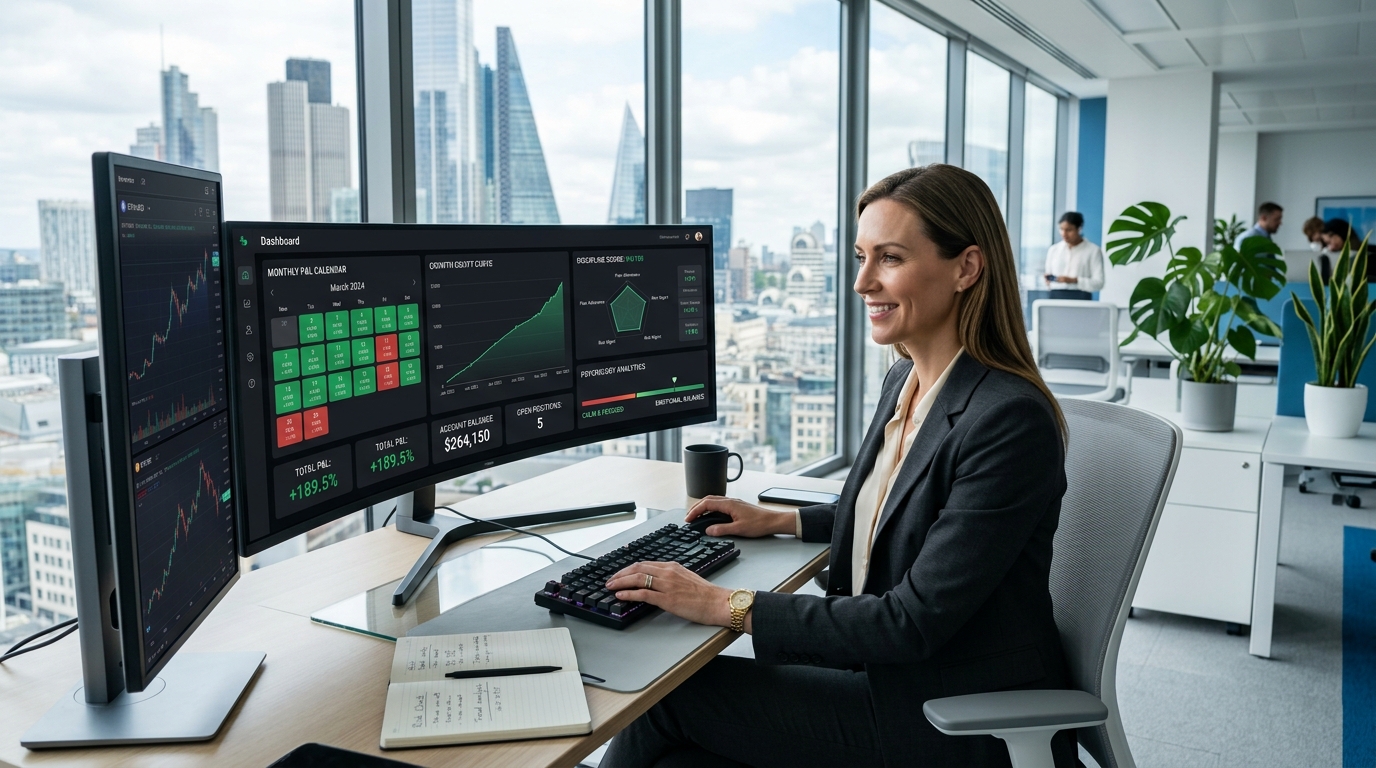
A lot of traders start journaling with good intentions and stop within a few weeks. Not because they lose interest in improving, but because manually recording every trade, entry, exit, size, notes, becomes repetitive fast, especially for anyone trading more than a handful of times a week. An automated trading journal is built around a simple idea: spend less time entering data by hand, and more time actually learning from it.
This isn't about removing the trader from the process. It's about removing the repetitive parts that cause people to abandon journaling altogether, so the habit that actually drives improvement, consistent review, has a real chance of sticking.
What Is an Automated Trading Journal?
An automated trading journal is a platform that reduces or eliminates manual data entry by syncing trade history directly from a broker or trading account, then automatically organizing and analyzing that data. Automation typically simplifies several parts of the journaling process at once:
Trade organization: Trades are sorted, tagged, and searchable automatically, rather than requiring manual filing into a spreadsheet.
Performance tracking: Win rate, risk-reward, and equity curve are calculated instantly as new trades come in.
Psychology reviews: Some platforms prompt for emotional notes at the time of logging, making this step less likely to be skipped.
Strategy tracking: Trades tagged to specific setups are aggregated automatically, showing performance by strategy without manual filtering.
Reporting: Weekly and monthly summaries are generated on their own, rather than being built by hand each time.
Why Manual Trading Journals Often Fail
Manual journaling isn't a bad approach in principle, but it fails for predictable, common reasons.
Forgetting to journal: After a long trading session, sitting down to manually log every trade is often the first thing skipped.
Incomplete records: Under time pressure, traders tend to log the basics, entry and exit, while skipping context like emotional state or lessons learned.
No review process: Even when trades are logged consistently, many traders never actually go back and review the data, which defeats the purpose entirely.
Spreadsheet fatigue: Formulas break, columns get cluttered, and maintaining a growing spreadsheet becomes its own chore separate from trading itself.
Missing screenshots: Chart context is often skipped simply because manually saving and attaching an image takes extra steps most traders don't bother with consistently.
No behavioral analysis: Spotting patterns like overtrading after a loss requires manually reviewing dozens of entries, something most traders don't have time to do thoroughly.
What Should Be Automated?
Not everything needs to be automated, but a few areas tend to offer the clearest benefit when handled automatically rather than manually:
- Automatic performance reports: Win rate, average risk-reward, and equity curve generated without manual calculation.
- Weekly summaries: A consistent snapshot of the week's trading, ready for review without extra setup.
- Monthly analytics: Longer-term trends that help separate normal variance from a genuine shift in performance.
- P&L Calendar updates: Daily profit and loss reflected automatically in a visual calendar view.
- Strategy statistics: Performance broken down by tagged setup, updated as new trades are added.
- Asset Performance tracking: Results segmented by instrument or asset class without manual filtering.
- Risk calculations: Position sizing and risk percentage calculated automatically for every trade.
- AI-generated performance summaries: Written overviews that highlight what changed and what stayed consistent over a given period.
- Trade Risk Planner calculations: Position size and risk figures calculated before a trade is even placed, supporting planning rather than only after-the-fact review.
How AI Improves an Automated Trading Journal
AI's role in a trading journal is specific and, importantly, limited. Used well, AI can identify recurring habits across a large trade history, summarize trading performance in plain language rather than raw numbers, highlight behavioral patterns like hesitation after a loss or overconfidence after a win, identify strengths and weaknesses across different strategies or sessions, and encourage consistent review by surfacing insights automatically rather than waiting for the trader to dig through data manually.
What AI should never do in this context is predict markets or replace trading decisions. A legitimate automated trading journal analyzes what a trader has already done, not what the market is about to do. Any platform blurring that distinction is doing something fundamentally different from journaling, and traders should be cautious of tools that frame AI analysis as market prediction.
How Automation Helps Trading Psychology
Beyond time savings, automation has a less obvious but meaningful effect on the psychological side of trading.
Reducing emotional bias: Automated, objective data is harder to rationalize away than a fuzzy memory of "it wasn't that bad."
Building discipline: Seeing consistent, automatically generated reports makes it easier to notice when actual behavior drifts from a stated plan.
Creating review routines: Automated weekly summaries give a natural, ready-made starting point for a review session, rather than requiring traders to build one from scratch.
Improving accountability: Data that's automatically tracked and visible removes the option to quietly ignore a weak metric.
Making progress measurable: Automated goal tracking turns vague intentions like "trade more disciplined" into specific, trackable metrics over time.
Features to Look For
When evaluating automated trading journal platforms, a few features tend to matter most in practice:
- Cloud syncing: Keeps trade data consistent and accessible across every device.
- Performance analytics: Automated calculation of win rate, risk-reward, and equity curve.
- Trading Psychology: Structured emotional tracking, ideally reviewed alongside performance data.
- Strategy Playbook: Setup-level tracking to identify which strategies are actually working.
- Asset Performance: Breakdown of results by instrument or asset class.
- Trade Risk Planner: Pre-trade risk and position size calculations to support planning, not just review.
- P&L Calendar: Visual daily performance tracking for spotting streaks and patterns.
- Weekly reports: Automated summaries that make consistent review realistic.
- AI Analysis: Behavioral pattern detection across a larger trade history than manual review would typically cover.
How DailyTraderz Uses Automation
DailyTraderz is one example of a platform built around this automated approach to journaling. It combines a core Trading Journal with AI Analysis for surfacing behavioral patterns, a Strategy Playbook for setup-level performance review, and Asset Performance tracking across different instruments.
Its Elite plan includes a Trade Risk Planner for calculating position size and risk before entering a trade, alongside a P&L Calendar for visualizing daily results and automated Reports for regular review. The platform also includes dedicated Psychology tracking, aimed at surfacing emotional and behavioral patterns rather than predicting where the market is headed. As with any AI-assisted tool in this space, the analysis is about the trader's own history and behavior, not market forecasting.
Frequently Asked Questions
What is an automated trading journal?
It's a platform that reduces manual data entry by syncing trade history automatically, then organizing and analyzing that data through dashboards, reports, and often AI-assisted insights.
Does automation replace the need to review my trades?
No. Automation organizes the data, but reviewing it, understanding what the statistics and patterns actually mean, still requires active involvement from the trader.
Can an automated trading journal predict market movement?
No. A legitimate automated trading journal analyzes your own historical trades and behavior. It does not predict prices or provide financial advice.
Why do most manual trading journals get abandoned?
Manual entry becomes repetitive, especially for active traders, and without automated prompts or reports, the review step is often skipped entirely, which removes most of the journal's value.
What's the difference between TradeZella, TraderSync, Tradervue, and Edgewonk?
These are established platforms in the trading journal space, each with a different emphasis, from trade replay to psychology-focused analytics. Comparing feature sets and pricing directly on each platform's site is the most reliable way to see which fits your workflow.
Is an automated trading journal worth it for beginners?
It can be, since automation removes some of the friction that causes beginners to abandon manual journaling early on, though a simpler free option may also be sufficient at first.
How does AI identify behavioral patterns in trading?
By analyzing a trader's own historical data, looking for recurring tendencies like performance dips after losing streaks or inconsistent position sizing over time.
What is a Trade Risk Planner?
It's a tool that calculates position size and risk before a trade is placed, supporting disciplined planning rather than only reviewing risk after the trade is closed.
Do automated trading journals work for Forex traders?
Yes, most modern platforms support Forex accounts alongside other asset classes, often including session and currency pair breakdowns specific to Forex trading.
How do I choose the right automated trading journal?
Compare based on which features matter most to you, whether that's psychology tracking, strategy playbooks, or asset performance breakdowns. Our guides to the Trading Journal App, Trading Journal Software, and Trading Journal Online all go deeper into specific comparisons, and our broader Trading Journal guide ties the full concept together.
If cost is a factor before deciding, our guide to the Free Trading Journal options walks through what's realistic to expect without paying for software. This kind of consistent, structured self-review is also supported by investor education resources from organizations like the FINRA Investor Education center, which emphasizes disciplined record-keeping and risk awareness as core habits for market participants.
Automation doesn't replace the discipline required to actually review your trading. What it does is remove enough friction that the habit has a real chance of sticking, which is often the difference between a journal that gets abandoned after two weeks and one that genuinely improves consistency over months. DailyTraderz is built around that idea, combining automated data tracking with AI-assisted insights aimed at long-term trading discipline and performance.